
Compassionate communication is one of the most practical skills I have found for reducing conflict and building real connection in everyday life. If you are looking to understand what compassionate communication is and how to use it, you are in the right place. It is not about being soft or avoiding hard conversations. It is about learning to speak in a way that keeps the other person open rather than defensive.
I remember a conversation with someone close to me that went completely sideways. I was certain I was being reasonable. Looking back, I was leading with judgment instead of honesty. That moment changed the way I approach almost every difficult conversation I have now. It taught me that the way I say something matters just as much as what I say.
Compassionate communication is the practice of expressing what you observe, feel, need, and want without blame or judgment. Anyone can start practising it today, in any conversation, by slowing down and focusing on their own experience rather than the other person’s faults.
What Compassionate Communication Actually Means
Most of us grew up learning to communicate reactively. When something bothers us, we say what we think about the other person rather than what we feel inside. Compassionate communication, sometimes called Nonviolent Communication or NVC, was developed by psychologist Marshall Rosenberg to change exactly that pattern.
At its core, it is a way of speaking that separates observation from evaluation. Instead of saying you always ignore me, you might say I noticed you did not respond to my message yesterday and I felt unimportant. The first triggers defensiveness. The second opens a conversation. Research published by Psychology Today confirms that this shift in framing consistently reduces conflict and improves relational outcomes.
The goal is not to win or to make the other person feel bad. The goal is to be understood and to understand in return.
The Four Basic Steps of Compassionate Communication
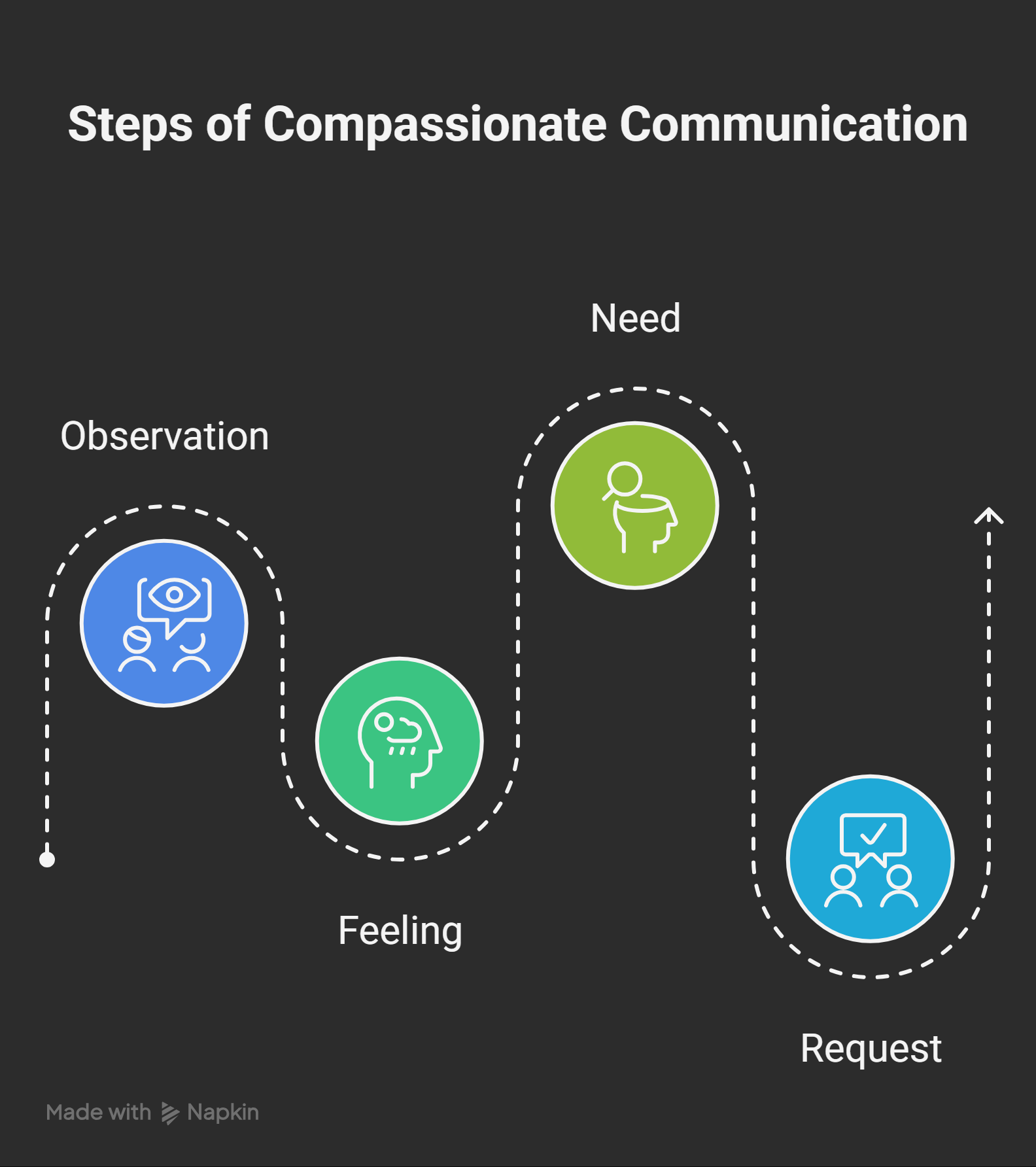
If you want to know what are the four basic steps of compassionate communication, they follow a simple and repeatable structure that you can practise in any conversation.
The first step is observation. You describe what you actually saw or heard without adding your interpretation. No labels, no conclusions, just the facts as you experienced them.
The second step is feeling. You name how that observation made you feel using an emotion word, not a thought disguised as a feeling. Saying I feel like you do not care is a thought. Saying I feel hurt is a feeling.
The third step is need. You identify the underlying need that is connected to that feeling. Feelings are always pointing to something deeper, a need for respect, connection, safety, or recognition.
The fourth step is request. You make a clear, specific, doable request that could meet your need right now. Not a demand, not a vague wish, but a real ask the other person can respond to.
How to Start Practising Compassionate Communication in Real Conversations
The most common reason people give up on compassionate communication is that it feels unnatural at first. That is normal. Like any skill, it takes repetition before it becomes fluid. Here is how to build it into real conversations without it feeling scripted.
Start by practising alone. Before a difficult conversation, write down what you observed, what you felt, what you needed, and what you want to ask. Getting it on paper first helps you slow down the emotional reactivity that usually hijacks the conversation before it begins.
Then focus on one step at a time. You do not need to deliver all four steps perfectly in a single conversation. Even just replacing your first reactive sentence with a feeling statement is progress. For more on what compassionate communication is and how it works, that deeper foundation will help you apply these steps with more confidence.
Also, listen as much as you speak. Compassionate communication is not just a speaking method. It is an approach to hearing the feelings and needs underneath what others say, even when they are not expressing themselves well.
Common Compassionate Communication Mistakes to Avoid
Even people who know the framework well fall into certain traps. The biggest one is using the language of compassionate communication as a way to be passive aggressive. Phrases that sound observational but carry a hidden accusation are not NVC. They are judgment in disguise.
Another common mistake is making requests that are actually demands. A real request leaves space for the other person to say no. If you feel angry or hurt when they decline, it was a demand. Learning to make genuine requests is one of the hardest parts of this practice and also one of the most liberating.
Finally, people often try to use compassionate communication only in conflict. The real power comes from practising it in everyday exchanges too, not just when something goes wrong. The more you use it routinely, the more natural it becomes under pressure.
Why Compassionate Communication Changes More Than Your Conversations
When you start communicating with more compassion, something shifts beyond your relationships. You begin to hear your own inner voice differently. The critical, blaming self-talk that many of us carry starts to soften. You start applying the same four steps to yourself, observing your own behaviour without judgment, feeling what you feel, identifying what you need, and asking for it rather than either suppressing it or demanding it.
That internal shift is what makes this practice so lasting. It is not just a communication technique. It is a way of relating to yourself and others that reflects the kind of person you want to be. The Humane Education Project frames it clearly: compassionate communication is as much about inner clarity as it is about outer expression.
Books like You Can Heal Your Life by Louise Hay — listen on Audible — and The Righteous Mind by Jonathan Haidt — listen on Audible — offer powerful complementary perspectives on how we speak to ourselves and how our moral emotions shape the way we hear and respond to others.
Frequently Asked Questions (FAQs)
What is the meaning of compassionate communication?
Compassionate communication is a way of expressing yourself that focuses on your own observations, feelings, and needs rather than blaming or judging others. It was developed by Marshall Rosenberg as a method to reduce conflict and increase genuine understanding between people. At its heart, it is about speaking honestly while remaining deeply aware of the humanity of the person you are speaking with.
What are the four basic steps of compassionate communication?
The four steps are observation, feeling, need, and request. You start by describing what you noticed without adding interpretation, then name how it made you feel, identify the need underneath that feeling, and finally make a clear and specific request. You can read a full breakdown of the four basic steps of compassionate communication on my site.
How does compassionate communication differ from regular communication?
Regular communication often involves reacting to what someone does or says by labelling them or their behaviour, which tends to create defensiveness. Compassionate communication redirects focus to your own inner experience, specifically your feelings and needs, rather than the other person’s actions or motives. The result is that conversations stay open rather than collapsing into argument or withdrawal.
A Personal Note Before You Go
I am not perfect at this. There are still days when I lead with frustration and say something I immediately wish I could take back. What compassionate communication has given me is a way back into connection faster than I used to manage. I know what went wrong because I know the structure. I can name it, own it, and return to honesty rather than staying in the wreckage of a bad moment.
If you take nothing else from this post, take this: slow down before you speak. One breath. One question to yourself about what you are actually feeling. That pause is where compassionate communication begins.
Make it a great day.
Connect With Me:
Get More
Explore More on Compassionate Communication
What Is Compassionate Communication?
What Are the Four Basic Steps of Compassionate Communication?
Recommended Reading
You Can Heal Your Life — Louise Hay
The Righteous Mind — Jonathan Haidt