
What Are the Four Basic Steps of Compassionate Communication?
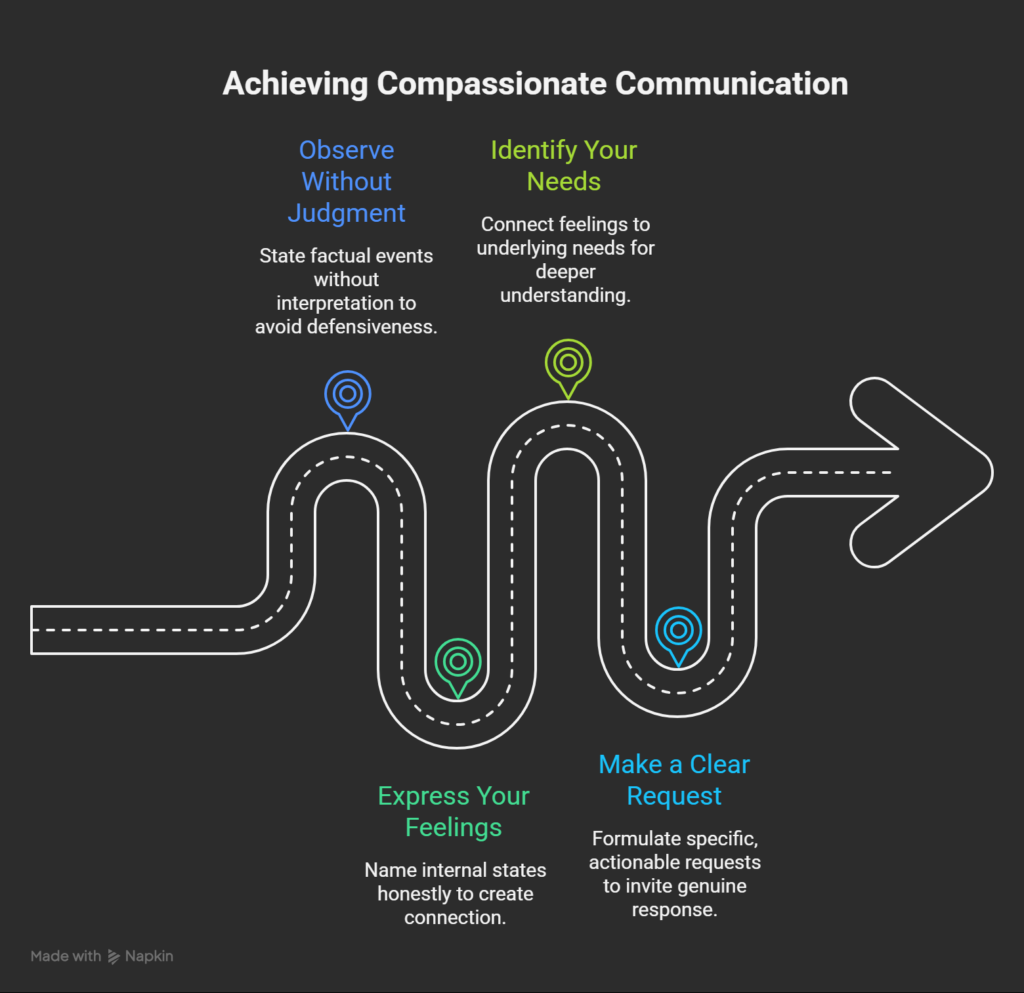
The four steps of compassionate communication form a deliberate sequence. Together, they create the conditions for honest, empathic exchange. Each step builds on the one before it — so following the order matters, especially when emotions are running high.
Step 1: Observe Without Judgment
The first step is to state what you actually observe — not your interpretation of it, but the concrete, factual event. This is harder than it sounds, because most of us blur observation and evaluation without realising it.
For example, saying “You are always dismissive” is an evaluation. However, saying “In our last three conversations, you checked your phone while I was speaking” is an observation. One triggers defensiveness immediately. The other opens a door to real dialogue.
When you separate observation from judgment, you give the other person something specific they can respond to. Additionally, you signal that you are interested in what actually happened — not simply in being right about it. That shift alone can change everything about how a conversation unfolds.
A useful inner question at this stage is: “If I filmed this moment, what would the camera see?” Anything the camera cannot capture is probably interpretation, not observation.
Step 2: Express Your Feelings
Once you have grounded the conversation in observation, the second step is to name how you feel. This step is often the most uncomfortable one. Many people were raised to conceal feelings in professional or tense personal situations. Nevertheless, feelings are data — and naming them honestly creates connection rather than distance.
There is a crucial distinction here that most people miss. Feelings are internal states: sad, anxious, relieved, overwhelmed, hopeful. By contrast, pseudo-feelings — like “I feel ignored” or “I feel manipulated” — are actually disguised interpretations of another person’s behaviour. Consequently, they tend to provoke defensiveness rather than empathy.
Therefore, practise naming what is actually happening inside you. “I felt hurt” lands very differently than “I feel like you don’t care.” One is a genuine feeling. The other is a verdict — and verdicts close conversations rather than opening them.
Moreover, expressing feelings is not about vulnerability for its own sake. It is about accuracy. When the other person knows what you actually feel, they have something real to respond to.
Step 3: Identify Your Needs
The third step asks you to connect your feeling to an underlying need. This is where compassionate communication becomes genuinely transformative. Behind every feeling lies a need — for safety, for connection, for respect, for clarity, for recognition, for rest.
Most conflict, at its root, is not really about the surface issue. Rather, it is about unmet needs that neither person has found words for yet. When you name your need clearly, you give the other person something they can actually engage with. Furthermore, you break the cycle of blame and counter-blame that keeps so many conversations stuck in the same place.
A simple example: “I felt anxious — because I need to feel like we are making decisions together” connects the feeling directly to the underlying need. As a result, the other person knows what truly matters to you, not just what upset you. That is a completely different conversation.
It helps to know that needs are universal. Everyone shares the same core needs, even when their strategies for meeting those needs look very different. Finding the need beneath the feeling is therefore also an act of recognising your shared humanity with the other person.
Step 4: Make a Clear Request
The fourth step is where many people stumble — even those who handle the first three well. After observing, expressing, and naming a need, the natural next move is to make a request. However, a request is fundamentally different from a demand. A request invites a genuine response. A demand assumes compliance and punishes refusal.
Requests in compassionate communication are specific, positive, and actionable. Instead of “Stop ignoring me,” try “Would you be willing to put your phone down when we talk?” One gives the other person something they can actually say yes to. The other puts them in the position of the accused.
Additionally, true requests hold space for “no.” If the other person cannot agree right now, that is useful information — not a failure or a rejection. In fact, a “no” often opens a deeper conversation about what they need instead. And that deeper conversation is frequently where real understanding begins.
For a clear breakdown of how each of these steps works in real-world situations, this resource from Experience Life offers practical examples of all four in action.
Why Each Step Works
These four steps are not arbitrary. Each one directly addresses a specific way that communication tends to break down under pressure.
Observation without judgment reduces defensiveness. When people do not feel accused, they are far more likely to stay present and engaged. Expressing feelings builds trust, because vulnerability offered carefully invites connection rather than conflict. Naming needs shifts the entire conversation from opposition to collaboration. And making requests — rather than issuing demands — preserves the other person’s autonomy and dignity throughout.
Together, therefore, the four steps create a conversation structure that serves both people. Neither person has to win. Instead, both people get to be heard — which is what most of us actually want, even when we don’t say it.
This is also why compassionate communication works even when only one person in the conversation is using it consciously. You do not need the other person to know the model. When you shift your own approach, the dynamic of the conversation changes. Often, the other person follows — not because they were instructed to, but because safety is contagious.
How to Apply the Four Steps in Real Life
Knowing the steps and using them under pressure are two very different experiences. So here is a practical framework for bringing compassionate communication into everyday conversations.
First, slow down before you speak. Most reactive communication happens in the gap between trigger and response — a gap that is often only a second or two wide. Even a single deliberate breath creates enough space for a different choice.
Second, start with observation. Before anything else, ask yourself: what actually happened? Strip away the story and name the facts. Then connect those facts to a feeling — a real internal state, not a verdict about what the other person intended.
Third, go one layer deeper and ask what you need. This step takes practice. Many people have spent years disconnected from their own needs, either because those needs were dismissed in childhood or because expressing them felt too risky. However, the more you practise naming them privately, the clearer they become in the moment.
Finally, form a request. Make it specific and positive. And hold it lightly enough that you can genuinely hear “no” without it becoming the end of the conversation.
You may also find that compassionate communication works especially well in quiet moments — not just in the middle of conflict. Conversations that happen before tension builds are often where the deepest foundations of connection are laid. For more on this dimension of communication, see: A Connection Beyond Words: How Healing Creates Unspoken Understanding.
What Blocks Compassionate Communication?
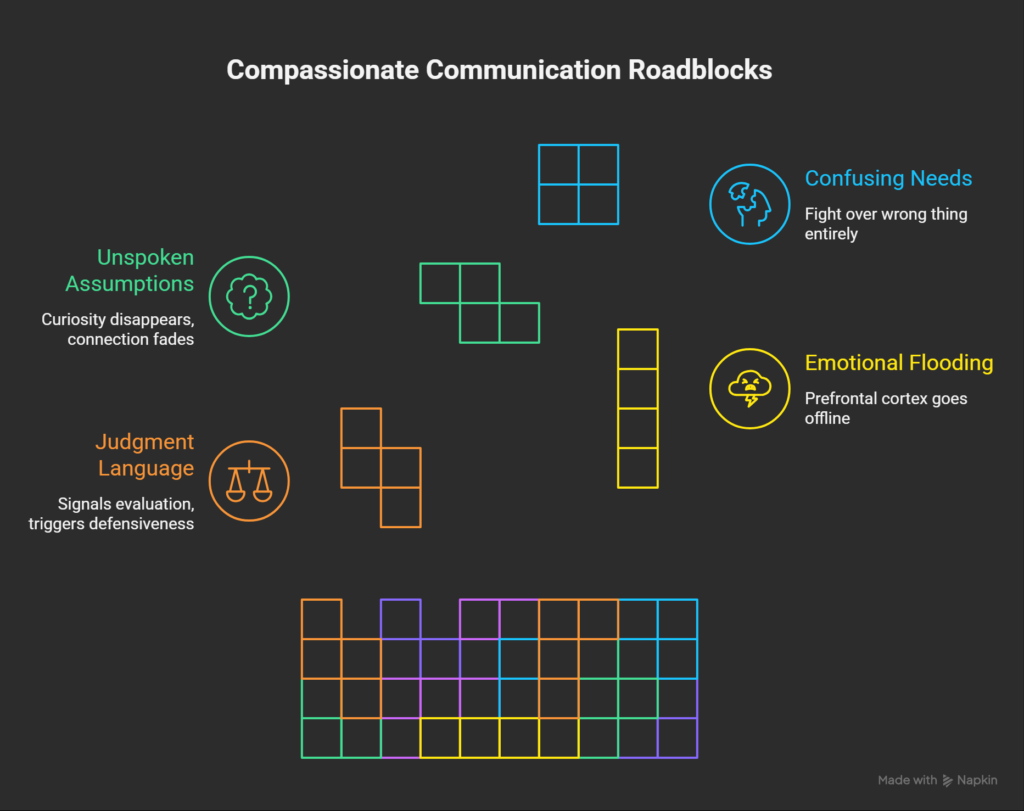
Even with genuine intention, certain patterns reliably get in the way. Understanding them is itself part of the practice.
Judgment language is the most common block. Words like “always,” “never,” “should,” and “wrong” signal evaluation rather than observation. They typically trigger defensiveness before the conversation has even found its footing.
Emotional flooding is another significant barrier. When the nervous system is overwhelmed, the prefrontal cortex — the part of the brain responsible for nuanced, considered communication — effectively goes offline. Therefore, pausing when you are flooded is not weakness. It is wisdom. Returning to the conversation when regulated will almost always lead to a better outcome.
Unspoken assumptions also undermine even well-intentioned exchanges. If you assume you already know why the other person behaved as they did, curiosity disappears. And without curiosity, compassionate communication becomes performance rather than genuine connection.
Finally, confusing needs with strategies creates quiet but persistent problems. A need is universal — belonging, safety, meaning, rest. A strategy is one possible way of meeting that need. When you argue about strategies without naming the underlying need, you often fight over the wrong thing entirely — and both people end up feeling unheard despite their best efforts.
For a useful look at the principles that underpin this approach, Bennett Twins offers a clear and practical breakdown worth reading alongside this post.
How Compassionate Communication Builds Over Time
Like any worthwhile practice, compassionate communication deepens with repetition. In the beginning, it can feel stilted — almost mechanical. That is completely normal. The four steps are a scaffold, not a finished structure. Over time, they become instinct rather than instruction.
In the early weeks, you will likely notice how often you skip straight to reaction. That noticing is itself progress. Then, gradually, you begin to catch yourself before the reaction. You create a pause. You choose a more precise word. You ask a question instead of making an assumption.
Over months, something more significant shifts. Relationships begin to feel safer — not because conflict disappears, but because people trust that difficult conversations will not destroy the connection. As a result, honesty becomes easier. Vulnerability becomes less costly. Connection becomes more consistent and more real.
The compounding effect of compassionate communication is genuine. Furthermore, it extends well beyond individual relationships. When you communicate with more care and precision, it affects the people around you — at work, at home, and in communities. The practice is personal. However, its impact is rarely private.
Frequently Asked Questions (FAQs)
What are the examples of compassionate communication?
Examples of compassionate communication include using observation-based language (“I noticed that the deadline was moved without a team discussion”), naming your emotional state honestly (“I felt worried when I heard about the change”), linking that feeling to a need (“because I need to feel included in decisions that affect my work”), and making a specific request (“Would you be willing to loop me in before the next change is confirmed?”). In everyday life, compassionate communication also shows up as active listening — staying present and curious rather than preparing your counter-argument while someone else is still speaking. Even a simple “help me understand what happened from your side” is an act of compassionate communication.
What is the meaning of compassionate communication?
Compassionate communication means speaking and listening in a way that honours both your own truth and the other person’s experience. It draws on honesty and empathy in equal measure. Rather than using language to control, blame, protect, or win, compassionate communication uses language to connect. At its core, it is about being real with people in a way that makes them feel safer — not more threatened or judged. It is also a deeply practical approach, grounded in the recognition that most conflict comes from unmet needs, not bad intentions.
What are the four basic steps of compassionate communication?
The four basic steps of compassionate communication are: (1) Observe without judgment — describe what happened in concrete, factual terms free from interpretation; (2) Express your feelings — name your internal emotional state without using the other person’s behaviour as the explanation; (3) Identify your needs — connect your feeling to a specific underlying universal need; and (4) Make a clear request — ask for something specific and actionable while remaining genuinely open to the other person’s response. Practised together, these four steps consistently replace blame and defensiveness with understanding and connection.
Everything You Need Is Already Here
You do not need a perfect vocabulary to begin practising compassionate communication. You do not need the other person to already be on board. You simply need the willingness to slow down, get honest about what you actually feel and need, and speak in a way that invites connection rather than conflict.
The four steps are a map. And like any map, they are most useful when you are in the territory — when conversations get hard, when feelings run high, and when the easy thing would be to react and the courageous thing is to respond.
Start small. Pick one conversation this week where you try observation before evaluation. Notice what changes. Then build from there — one honest, careful, compassionate exchange at a time.
Make it a great day.
Get More…
Learn more about Intentional Living on tomcgraham.com →
Learn more about Mindfulness Practices on tomcgraham.com →
Learn more about Emotional Resilience on tomcgraham.com →
Free PDF Downloads
True Self Alignment | Download PDF on tomcgraham.com →
Embracing Imperfection | Download PDF on tomcgraham.com →
Emotional Waste | Download PDF on tomcgraham.com →
Recommended Reading
Fierce Conversations — Susan Scott →