
Compassionate communication changed the way I show up in almost every conversation that matters.
Not because I read about it and instantly got it right. But because I kept getting it wrong, raising my voice when I meant to be honest, going quiet when I needed to be clear — until I understood what was actually missing. What was missing was not better words. It was a different intention behind them.
This post covers everything you need to know about compassionate communication. What it is, what it is not, the four steps that make it work, real-world examples, and how to start building the skill today. Whether you are new to this or have been exploring it for a while, this is your complete reference.
In short: Compassionate communication is the practice of speaking and listening with honesty, empathy, and clear intention. It draws on the work of Marshall Rosenberg and the Nonviolent Communication (NVC) model. The core skill is learning to express what you need without blame — and to hear others without defensiveness. Anyone can begin practising it today.
What Is Compassionate Communication?
Compassionate communication is a way of speaking and listening that prioritises connection over being right. It is rooted in the belief that most conflict comes not from bad people but from unmet needs expressed badly.
The term is most closely associated with Marshall Rosenberg, who developed Nonviolent Communication in the 1960s. Rosenberg argued that the way most people communicate — with judgements, demands, and blame — actually prevents the understanding they are looking for. Compassionate communication offers a different path.
According to Experience Life, compassionate communication means expressing yourself fully and honestly while remaining genuinely open to the other person’s experience. That balance — honesty and openness at the same time, is what makes it both powerful and difficult to sustain.
It is also worth being clear about what it is not. Compassionate communication is not about being nice at the expense of being honest. It is not conflict avoidance. It is not softening everything until it loses meaning. It is a structured, learnable approach to expressing truth in a way that keeps connection intact.
What Are the Four Basic Steps of Compassionate Communication?
The four steps come directly from Rosenberg’s NVC model. They give the practice its structure. Without them, compassionate communication becomes a vague intention. With them, it becomes a repeatable skill.
Step 1 — Observation
The first step is to describe what happened without evaluation or judgement. You separate the fact from the story you are telling yourself about it. Instead of saying “you were rude,” you say “you walked out of the room while I was still speaking.” One is a label. The other is what actually occurred. Therefore, this step alone changes the tone of almost every difficult conversation.
Step 2 — Feeling
The second step is to name what you are genuinely feeling — not what you are thinking. There is a clear difference between “I feel like you don’t care” (a thought) and “I feel hurt” (a feeling). This step requires honesty and a degree of vulnerability that most people find uncomfortable at first. However, it is the step that opens the door to real understanding.
Step 3 — Need
The third step is to identify the unmet need underneath the feeling. Feelings are signals. They point to needs. Hurt often points to a need for respect or acknowledgement. Frustration often points to a need for clarity or progress. Because naming the need shifts the conversation from blame to understanding, this step is where the real shift happens.
Step 4 — Request
The fourth step is to make a clear, specific, doable request — not a demand. A request leaves room for the other person to say no without consequence. A demand does not. This distinction matters because genuine connection cannot be forced. It can only be invited.
These four steps — Observation, Feeling, Need, Request — are the foundation of compassionate communication. The Mental Wellness Center describes this framework as one of the most effective tools available for reducing relational conflict and building emotional safety in both personal and professional settings.
What Are Examples of Compassionate Communication?
It is one thing to understand the steps in theory. It is another to hear what they actually sound like in real life. Here are examples across three common situations.
In a relationship
Without it: “You never listen. You are always on your phone.”
With it: “When I am talking and I notice you looking at your phone, I feel dismissed. I need to feel like what I am saying matters to you. Would you be willing to put your phone down when we are talking?”
Same concern. Completely different landing point.
At work
Without it: “You dropped the ball on this. This is not good enough.”
With it: “The report came in two days after the deadline. I felt frustrated because I had planned the client meeting around that date. I need us to be able to rely on agreed timelines. Can we talk about what got in the way and how we handle it going forward?”
One creates defensiveness. The other creates a conversation.
With yourself
Compassionate communication is not only for outward conversations. It also applies to how you speak to yourself. Many people use internal language they would never use with someone they care about. Noticing that pattern , and deliberately shifting it, is one of the most impactful places to begin.
If you are working on healing and want to understand how communication connects to deeper emotional repair, this piece on a connection beyond words and how healing creates unspoken understanding goes much deeper into that territory.
Why Compassionate Communication Matters
Most people were never taught how to communicate with intention. Instead, they learned by watching , parents, teachers, media. and inherited whatever patterns were modelled for them. Some of those patterns were useful. Many were not.
The cost of poor communication is real. Relationships break down not because people stop caring but because they stop understanding each other. Resentment builds not from big events but from small interactions handled badly, repeated over time.
Compassionate communication interrupts that cycle. It does not guarantee that every conversation will go perfectly. However, it significantly increases the likelihood that both people will leave feeling heard, and that is the foundation everything else is built on.
Research and practice both support this. Humane Education outlines several practices for cultivating compassionate communication skills, emphasising that the skill is built through consistent, deliberate repetition, not through a single insight or breakthrough moment.
How to Start Building Compassionate Communication Skills
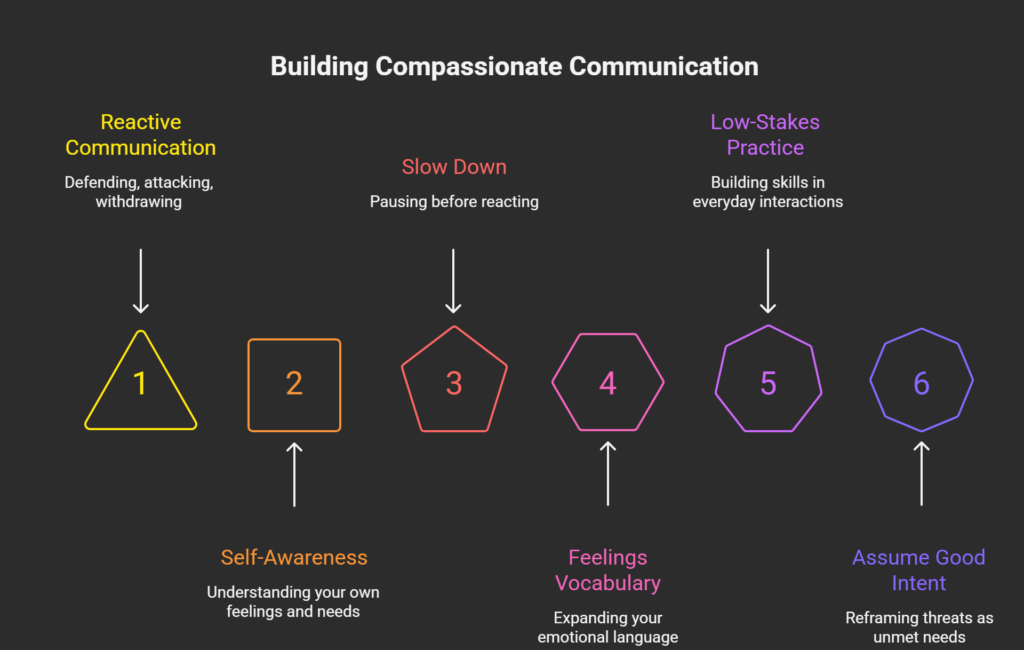
The gap between knowing this and doing it is bridged by practice. Here is where to begin.
Start with self-awareness
Before you can communicate compassionately with others, you need to know what you are actually feeling and what you genuinely need. Many people are disconnected from both. A simple daily practice, five minutes of honest reflection at the end of the day , starts building that awareness quickly and quietly.
Slow the conversation down
Reactive communication is almost never compassionate. When you feel the urge to defend, attack, or withdraw, that is exactly the moment to pause. A breath, a beat, a simple “give me a second to think about that” creates enough space for a different kind of response to emerge.
Build your feelings vocabulary
Most people have a limited feelings vocabulary. They say they are “fine,” “annoyed,” or “upset” and stop there. The more precisely you can name what you are feeling, the more clearly you can communicate it. Expanding that vocabulary is one of the most practical and underrated steps you can take.
Practise with low-stakes conversations first
Do not wait for a difficult conversation to try this for the first time. Start with everyday interactions, with a colleague, a friend, a family member,w here the emotional stakes are lower. Build the muscle before you need it most.
Assume good intent
One of the quieter foundations of compassionate communication is the assumption that the other person is not trying to hurt you. They are most likely managing their own unmet needs. That single reframe — from threat to unmet need — changes everything about how you listen and how you respond.
Compassionate Communication Builds Over Time
Like any real skill, this one compounds. The first few weeks feel effortful and sometimes awkward. You will catch yourself mid-sentence and correct course. You will miss the moment entirely and wish you had said something differently.
That is part of it. Therefore, do not measure yourself against individual conversations. Measure yourself by patterns. Are your difficult conversations going slightly better than they were three months ago? Are you recovering from misunderstandings more quickly? Are you less reactive than you used to be?
Those shifts — quiet, gradual, and cumulative — are the evidence that compassionate communication is becoming part of how you live rather than something you are effortfully trying to do.
Frequently Asked Questions (FAQs)
What are the examples of compassionate communication?
Examples of compassionate communication include expressing a concern without blame (“When this happens, I feel…”), making a specific request rather than a demand, and listening without planning your response while the other person is still speaking. It also includes the internal language you use with yourself — shifting from self-criticism to honest, kind self-reflection. In practice, compassionate communication sounds less like a debate and more like two people genuinely trying to understand each other.
What is the meaning of compassionate communication?
Compassionate communication means speaking and listening in a way that prioritises honesty, empathy, and connection. It is a structured approach — most closely associated with Marshall Rosenberg’s Nonviolent Communication model — that helps people express what they are feeling and needing without blame or judgement. The goal is not to win an argument. The goal is to understand and to be understood.
What are the four basic steps of compassionate communication?
The four steps are Observation, Feeling, Need, and Request. First, describe what happened without judgement or evaluation. Second, name what you are genuinely feeling. Third, identify the unmet need underneath that feeling. Fourth, make a clear and specific request, one the other person can freely say yes or no to. These four steps give compassionate communication its structure and make it a learnable, repeatable skill rather than a vague aspiration.
Everything You Need Is Already Here
Compassionate communication is not a technique you master once and check off a list. It is a way of being in conversation, with others and with yourself, that deepens the more consistently you practise it.
The concepts here, the four steps, the real-world examples, the daily entry points , are your starting point. Not a destination. Follow whichever thread is calling you most right now, and keep going.
Make it a great day.
Recommended Reading
Fierce Conversations — Susan Scott →