
Intentional living made sense to me long before I could actually sustain it. I understood the idea. I wanted it. I had moments of real clarity where my choices aligned with what mattered and everything felt coherent. Then life would get complicated, motivation would drop, and I would find myself back in default mode without quite knowing when the slide had started. What I was missing was not better intentions. I was missing structure. The principles in this post gave me that structure. They are not rules I follow perfectly. They are reference points I return to when things get unclear.
These eight principles are not a system to implement all at once. They are not a checklist to complete before intentional living counts as real. They are foundations. Each one holds a different part of the practice in place. Together they create something more durable than motivation, which fades, and more flexible than a rigid routine, which breaks. If you are still getting clear on what intentional living actually means before applying its principles, this post on the foundation of what intentional living means is the right place to start.
The key principles of intentional living include clarity about values, deliberate decision-making, consistent reflection, alignment between actions and priorities, and the willingness to say no to what does not serve your direction. Together these principles create a framework that makes intentional living sustainable rather than occasional.
Why Intentional Living Needs Principles, Not Just Intentions
Intentions are the starting point. They are not enough on their own. Almost everyone has good intentions about how they want to live. Almost everyone also has a life that regularly pulls them away from those intentions without their full awareness. The gap between intending to live intentionally and actually doing it consistently is not a character flaw. It is a structural problem.
Without principles to return to, intentional living becomes dependent on motivation. And motivation is unreliable. It peaks when you are inspired and disappears when you are tired, pressured, or simply moving through an ordinary week with no obvious reason to pause and choose carefully. Principles exist to hold the practice in place when motivation is not doing the job.
Think of them as infrastructure rather than inspiration. You do not need to feel inspired to follow a principle. You simply need to remember it exists and apply it to the decision in front of you. As this reflection on what living an intentional life actually requires in practice describes, the people who sustain intentional living over time are not necessarily more disciplined than those who do not. They have a clearer structure to return to when life pushes back. These eight principles are that structure.
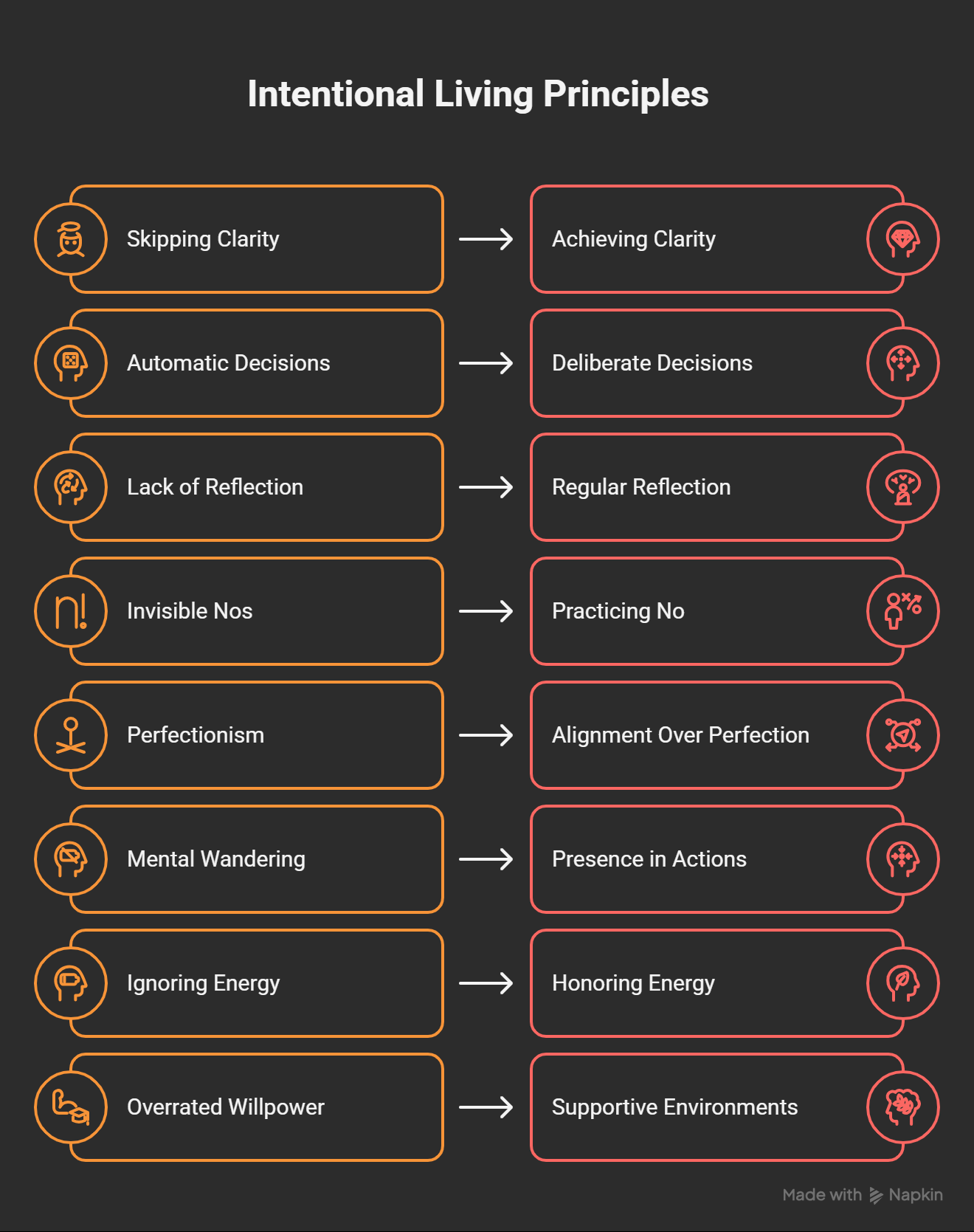
Principle One: Clarity About What Matters
You cannot live intentionally without knowing what you are being intentional toward. This sounds obvious and it is. It is also the principle most people skip because getting clear on what actually matters is uncomfortable. It requires separating what you genuinely value from what you have been taught to value, what looks good from the outside, and what is simply easier to pursue than to question.
In my own experience, this clarity did not arrive as a single revelation. It emerged gradually through a process of noticing where my best energy was going and whether I had actually chosen to put it there. One practical starting point is to look at the last two weeks of your life. Where did your time go? Where did your attention go? Does that distribution reflect what you would say matters most to you? The gap between your answers is where the clarity work begins.
Clarity is not a permanent state. It requires maintenance. Values shift as life changes, and the version of clarity you arrived at two years ago may not be the right map for where you are now. The principle is not to achieve perfect clarity once but to return to the question of what matters regularly enough that your choices stay grounded in something real rather than something assumed.
Principle Two: Deliberate Decision-Making
Most decisions are not really made. They happen. Someone asks, and you say yes automatically. A habit kicks in, and you follow it without noticing. The path of least resistance presents itself, and you take it without asking whether it leads anywhere you actually want to go. Deliberate decision-making is the practice of inserting a pause between the prompt and the response.
That pause does not need to be long. For most decisions, fifteen seconds is enough. The question the pause contains is simple: does this choice reflect what matters to me, or is it just the easiest option? That single question, applied consistently to the decisions that shape your time and energy, is one of the most practically powerful expressions of intentional living available.
The pause is hardest to maintain under pressure and in social situations where an immediate response feels expected. Those are also the moments where it matters most. Saying yes to the wrong things in those moments is how the gap between intentions and actual life gets built. According to this guide to building intentional living into daily decision-making, the single most consistent characteristic of people who live intentionally is not any particular habit or routine. It is the practice of pausing before committing, in ways that are small enough to be sustainable and frequent enough to accumulate into a genuinely different relationship with their own choices.
Principle Three: Regular Reflection
Without reflection, intentional living becomes a performance rather than a practice. You can tick the boxes, maintain the habits, say the right things about what matters, and still drift steadily away from genuine alignment without noticing. Reflection is what closes that gap. It is the mechanism that catches drift before it becomes distance.
My own reflection practice is not elaborate. At the end of each week I ask three questions. Was this week aligned with what matters to me? What pulled me off course? What do I want to do differently next week? That is it. The questions take ten minutes if I am thorough and three minutes if I am brief. What they produce is a weekly recalibration that prevents the kind of slow drift that otherwise goes unnoticed for months.
Daily reflection can be even simpler. One question at the end of the day: did I choose how I spent my attention today, or did I just respond to whatever arrived? The answer does not need to be yes for the reflection to be valuable. The awareness itself is the point. Intentional living is not about having perfect weeks. It is about knowing what kind of week you had and using that knowledge to make better choices in the one that follows.
Principle Four: Saying No as a Practice
Every yes contains a hidden no. When you say yes to something, you are simultaneously saying no to whatever else you could have done with that time, energy, and attention. Most people are aware of this in theory. In practice, the nos are invisible and the yeses feel harmless, especially when the thing being offered is reasonable, flattering, or socially expected.
The ability to say no without excessive guilt is one of the most practical and most difficult expressions of intentional living. It is difficult because it requires prioritising your own direction over other people’s expectations, and because the social cost of a clear no is usually more visible than the quiet cost of a misaligned yes. The misaligned yes costs you in accumulated ways that are easy to ignore until they are not.
What makes saying no easier over time is clarity about what you are saying yes to instead. When you know what matters and you can articulate it, even just to yourself, a no becomes less like a refusal and more like a redirection. You are not declining the opportunity in front of you arbitrarily. You are choosing, deliberately, to protect something that matters more. That reframe does not eliminate the discomfort of saying no. It makes the discomfort worth it.
Principle Five: Alignment Over Perfection
Intentional living does not ask you to get everything right. It asks you to notice when you have drifted and return without unnecessary self-punishment. The standard is not perfection. It is alignment. And alignment is a direction, not a destination. You are either moving toward what matters or you are not, and the question you ask yourself is not whether you have arrived but whether your choices are pointing the right way.
This principle is the one that keeps people practising. Perfectionism kills intentional living quickly because it makes every imperfect week feel like failure. And every week will be imperfect. There will be automatic yeses that should have been nos. There will be weeks where the reflection got skipped and the clarity got cloudy. Alignment over perfection means those weeks are part of the practice rather than evidence that the practice has failed.
The return is what matters. Every time you notice the drift and make one more deliberate choice, you are practising intentional living. Not perfectly. Consistently. And consistency over time, even imperfect consistency, is what produces the compounding changes that make intentional living feel, eventually, like it belongs to you rather than something you are effortfully maintaining.
Principle Six: Presence in Your Actions
Choosing the right things matters. Showing up fully for them matters just as much. You can make a deliberate yes and still be mentally elsewhere while doing it—planning the next task, replaying a conversation, scrolling without awareness. Intentional living asks for more than correct choices. It asks for presence within the choices you make.
Presence is not a meditation technique you add to your day. It is the quality you bring to whatever you are already doing. Eating while actually tasting. Listening without formulating your response. Working on one thing without splitting your attention across three. The practice is simple and the resistance is real: your mind will want to be somewhere else. The principle is to notice when it has wandered and gently return.
This does not require perfect focus. It requires a recurring intention to be where you are. Over time, that intention changes the texture of your days. Tasks feel less like obligations and more like experiences. And the gap between what you choose and how you live it narrows, not through effort but through attention.
Principle Seven: Honoring Your Energy, Not Just Your Time
Time is finite. Energy is renewable—but only if you treat it as something to protect and replenish. Most productivity advice focuses on scheduling your hours. Intentional living asks you to schedule your capacity. The same hour can hold deep work or shallow distraction depending on the energy you bring to it. The principle is to make choices based on what sustains you, not just what fits on the calendar.
In practice, this means noticing the difference between tasks that drain you and tasks that restore you—and building your week around that awareness. It means saying yes to rest before you are exhausted. It means recognizing that a low-energy day is not a failed day but a signal to adjust your expectations. Energy awareness turns intentional living from a mental exercise into a bodily practice.
This principle is especially important because energy is less visible than time. You can see a calendar slot. You cannot see your reserve of focus or emotional bandwidth until it is gone. The practice is to check in with yourself before committing: do I have the energy for this, or am I agreeing from depletion? That question, asked regularly, prevents the slow burnout that undermines even the best intentions.
Principle Eight: Cultivating Supportive Environments
Willpower is overrated. Environment is underrated. You can hold the clearest values and still find yourself pulled off course by a space, a routine, or a relationship that works against your direction. Intentional living includes the principle that your surroundings shape your choices more than your intentions do. The practice is to design environments that make the right choice the easy choice.
This applies to physical space, digital space, and social space. A phone that lives in another room supports focus more than a promise to resist checking it. A calendar shared with someone who respects your priorities supports boundaries more than internal resolve alone. A community that asks honest questions supports clarity more than solitary reflection. The principle is not to control everything around you but to notice what helps and what hinders—and adjust accordingly.
Cultivating supportive environments is not about perfection or isolation. It is about small, consistent adjustments that accumulate. Moving one object. Unfollowing one account. Having one conversation about what you are trying to live toward. Each adjustment reduces the friction between your intentions and your actual life. And over time, the environment you have shaped begins to shape you back, in ways that make intentional living feel less like effort and more like flow.
Frequently Asked Questions:
What are the core values of intentional living?
The core values of intentional living vary by person but typically include clarity, alignment, presence, and purpose. What matters is that the values are genuinely yours rather than inherited from external expectations. Intentional living begins with identifying what you actually care about rather than what you are supposed to care about. This reflection on living an intentional life explores what those core values look like in practice and why personalising them is more important than adopting someone else’s framework.
How do I apply the principles of intentional living every day?
Start with one principle at a time. Clarity comes first because without it the other principles have no direction. Once you know what matters, deliberate decision-making and regular reflection follow naturally. The goal is not to apply all eight principles simultaneously but to build them one at a time into the structure of your day. This helpful guide to living an intentional life offers practical entry points for each principle that work within ordinary schedules and full lives.
What is intentional living and how does it connect to mindfulness?
Intentional living and mindfulness practices share the same foundation: present-moment awareness applied to choices and actions. Mindfulness trains you to notice what is happening inside you. Intentional living trains you to use that awareness to make choices that reflect your values. They reinforce each other naturally, and developing one tends to strengthen the other over time. This post on what intentional living means explores that foundation in full before the principles apply.
Principles Are Not a Checklist. They Are a Compass.
You will not apply all eight principles every day. You will forget some of them for stretches at a time. There will be weeks where clarity gets cloudy, reflection gets skipped, and the nos come out as yeses because saying no was too complicated in that particular moment. None of that means the principles have stopped working. It means you are human, living a full and imperfect life, which is exactly the context these principles were designed for.
What matters is that you have something to return to when you notice you have drifted. A compass does not stop pointing north because you walked east for a while. It simply shows you where north is when you are ready to look again. These eight principles are that compass. Use them not as a standard to meet but as a direction to face. The facing is enough to begin.
Make it a great day.
Connect With Tom C Graham
If this resonated, there is more waiting for you. Explore tools, reflections, and resources across all six pillars of growth at tomcgraham.com. New episodes go up weekly on my YouTube channel, so subscribe so you do not miss them. And if you want to work through this alongside others asking the same honest questions, come find us in the Ripple Makers Facebook Group. You are welcome there.
Get More…
Learn more about Intentional Living on tomcgraham.com →
Learn more about Mindfulness Practices on tomcgraham.com →
Learn more about Emotional Resilience on tomcgraham.com →
Free PDF Downloads
True Self Alignment | Download PDF on tomcgraham.com →
Embracing Imperfection | Download PDF on tomcgraham.com →
Emotional Waste | Download PDF on tomcgraham.com →
Recommended Reading
Fierce Conversations — Susan Scott →