
The 5 R’s of mindfulness changed how I approach not just my meditation cushion, but every difficult moment in between. Before I found this framework, I had been practicing mindfulness with mixed results. I understood the theory well enough. I could sit with my breath during quiet moments. But when real life happened, when someone said something that stung or when anxiety arrived uninvited, all that practice seemed to vanish into thin air. I would react first and reflect later, and the gap between those two things felt impossible to close.
Then I came across a framework that gave my practice a practical spine. It did not ask me to be calmer or more enlightened or more spiritually advanced. It simply gave me five steps to move through when things got hard. Five words I could remember. Five stages that made sense of what was happening inside me. I want to share that framework with you here because I suspect you are where I was. You already know mindfulness matters. Perhaps you have tried it before. You have felt moments of genuine clarity. But you are looking for something that works when you need it most, not just when life is quiet and the conditions are perfect.
A Five-Step Sequence for Real Life
The 5 R’s of mindfulness are a five-step framework designed to help you move from automatic reaction to conscious response in moments of stress, difficulty, or emotional intensity. The steps are Recognize, Release, Relax, Reorganize, and Respond. Each one builds on the one before it, creating a sequence you can follow in real time without needing years of meditation experience or a dedicated practice space. For example, imagine you receive an email that triggers frustration. Before the 5 R’s, you might fire off a reply you later regret. With the framework, you have a structured way to pause, settle your nervous system, see the situation more clearly, and choose a response that aligns with who you want to be. This framework is for anyone who has ever known what mindfulness looks like on paper but struggled to apply it in the heat of a real moment. In other words, it is for almost all of us.
Where Did the 5 R’s Come From?
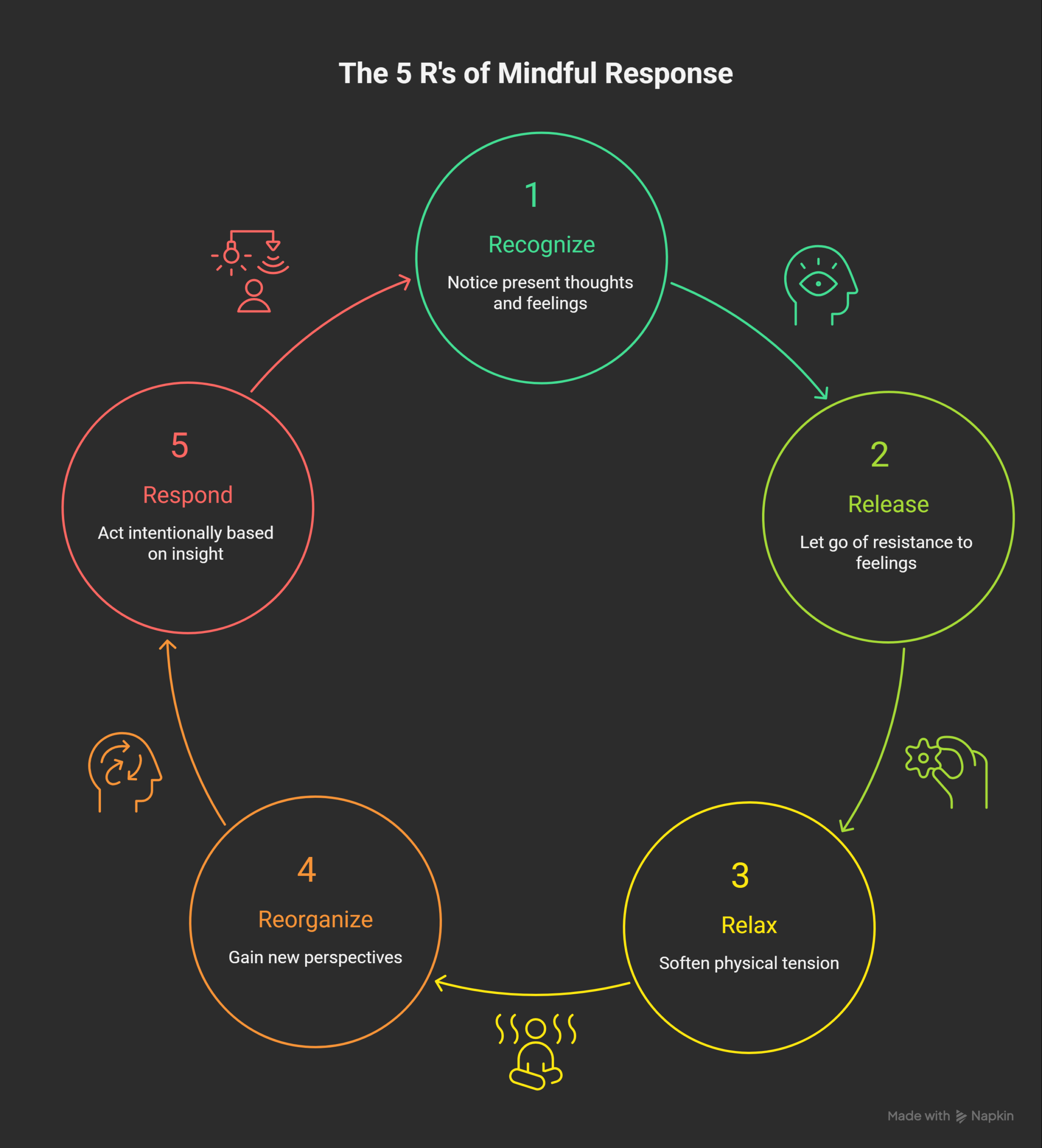
The 5 R’s of mindfulness draw from a range of therapeutic traditions, including mindfulness-based stress reduction, cognitive behavioural approaches, and somatic psychology. Different teachers and clinicians have offered variations of this sequence over the years, but the core insight remains consistent. The path from reaction to response follows a predictable arc, and naming each stage makes it easier to walk.
What makes this framework so accessible is that it does not require a formal meditation practice. You can apply it while sitting in traffic, during a difficult conversation with your partner, or lying awake at three in the morning. It is mindfulness designed for real life, not just the cushion or the meditation studio. And because the steps are concrete and sequential, even someone who has never meditated can begin using them immediately.
Step 1: Recognize
The first step sounds deceptively simple. Recognize what is happening. But most of us spend our days on autopilot, moving from one task to the next without pausing to notice what is actually going on inside us. We are so conditioned to keep moving that stopping feels unnatural, almost uncomfortable.
Recognition means turning your attention inward for a moment and asking a straightforward question. What is here right now? Not what should be here. Nor what you wish were here. And certainly not what you think a good meditator would feel. What is actually present, without judgment or spin. You might notice a tightness in your chest, a churning in your stomach, a repetitive thought circling in your mind like a recording you cannot turn off. The specific content does not matter as much as the simple act of noticing.
This is where genuine mindfulness begins. Without recognition, the other steps cannot follow because you are still operating from habit, still running on the old programming. The act of naming what is happening, even silently to yourself, creates a small gap between the stimulus and your response. In that gap lies your freedom. It is not a huge dramatic shift. It is a tiny pause. But that pause changes everything.
If you are new to this practice, start here. Spend a week simply noticing what arises without trying to change anything. Notice when you are tense, when you are rushing, when you are holding your breath. That alone marks a significant shift from how most people live, and it lays the foundation for everything that follows.
For a deeper look at how to build this foundational skill, read more about what mindfulness practices actually are and how they create the conditions for genuine self-awareness.
Step 2: Release
Once you have recognized what is present, the natural impulse is to do something about it. You want to fix the discomfort, push it away, distract yourself with your phone, or argue with the feeling. Release is the practice of consciously letting go of that urge, at least for this moment.
This does not mean suppressing your feelings or pretending everything is fine when it is not. That would be bypassing, not mindfulness. Release means relaxing the grip of your resistance. You stop fighting what is already here. Imagine your hand clutching something tightly, your knuckles white with the effort of holding on. Release is simply opening your fingers. You are not throwing the object away. You are just no longer holding it with force. The feeling can still be there. You are simply not adding the second layer of tension that comes from resisting it.
In practice, this might sound like taking a breath and saying to yourself, it is okay that this is here. I do not need to fix it right now. Or simply, let me allow this to be what it is. The release step is often the most counterintuitive because our entire culture trains us to be problem solvers, to fix things, to make discomfort go away as quickly as possible. But some things do not need solving. They need witnessing. And when you stop trying to solve them, they often begin to shift on their own.
Research from the Greater Good Science Center at UC Berkeley has documented that the practice of letting go of resistance is strongly associated with lower stress levels and greater emotional wellbeing over time. You are not ignoring your problems. You are choosing which ones to engage right now and which ones to simply allow.
Step 3: Relax
With recognition and release in place, the body has space to soften. This is not about collapsing into passivity or escaping your responsibilities. It is about consciously relaxing the physical tension that accompanies emotional distress, and that act of conscious relaxation sends a powerful signal through your entire system.
How Your Nervous System Responds
When you recognized the stress and released the resistance, your nervous system received an initial signal. It might be safe to down-regulate now. The relax step is where you follow through on that signal with intention. Drop your shoulders away from your ears. Unclench your jaw. Let your tongue rest at the bottom of your mouth. Take three slower, deeper breaths than the ones you have been taking. Feel your feet on the floor and the weight of your body in the chair.
This step matters because the mind and body are not separate. You cannot think your way out of a dysregulated nervous system, but you can breathe your way into a calmer one. The mind will follow the body more readily than the body follows the mind. When you relax physically, the mental stories begin to lose their grip. The relax step directly supports your nervous system in returning to a state of equilibrium, and that physiological shift creates the conditions for clearer thinking.
If you struggle with chronic stress or anxiety, this step is especially important. Many of us have lived in a state of low-grade activation for so long that we have forgotten what genuine relaxation feels like. We mistake numbness for calm and distraction for peace. The 5 R’s offer a structured invitation to come back to baseline, to remember what it feels like to be settled in your own body.
For more on how mindfulness practices directly support nervous system health and reduce the physiological toll of chronic stress, take a look at this article on managing your nervous system for better mental health.
Step 4: Reorganize
Once the system settles, something shifts. You are no longer trapped in the tunnel vision of your initial emotional response. You are looking at the situation from a place of greater clarity. This is the reorganize step, where you allow a new perspective to emerge naturally.
Reorganization does not mean forcing yourself to see the bright side or engaging in what has been called toxic positivity. That would be another form of suppression dressed up as growth. It means acknowledging that the initial story you told yourself about what is happening might not be the whole truth. Consider the email that felt like a personal attack. It might have been poorly worded but well-intentioned. The silence from a friend might have nothing to do with you and everything to do with what they are carrying. Even the setback at work might contain information you need rather than a verdict on your abilities.
Cognitive flexibility, the ability to see a situation from multiple angles, is one of the most well-researched benefits of consistent mindfulness practice. When your nervous system is calm, your prefrontal cortex can do the job it was designed for. You can weigh options, consider alternative interpretations, and make decisions that align with your values rather than your triggers. Now you are no longer running on instinct. Instead, you are running on insight.
This step often brings a quiet sense of relief, a small exhale of the soul. The external situation has not changed at all, but your relationship to it has. You are no longer trapped inside the reaction. You have room to move, to breathe, to choose.
For more on the foundational practices that make this kind of cognitive flexibility possible, the post on the basics of mindfulness practice offers a clear starting point.
Step 5: Respond
The final step is where all the inner work finds its outward expression. Having recognized what was present, released resistance, relaxed the body, and reorganized your perspective, you are now in a position to respond intentionally rather than react automatically.
A response comes from awareness. A reaction comes from habit. They can look identical on the outside but feel completely different on the inside. When you respond, you have choice. You can see multiple options and select the one that best aligns with your values. When you react, you are running a program that was written years ago, possibly decades ago, and it may no longer serve you.
This might mean saying something different in a difficult conversation than you would have said before. It could mean choosing not to send that email until tomorrow morning when you have had time to reflect. You might finally set a boundary you have been avoiding. Or it could simply mean returning to your day with a lighter heart and a clearer mind. The specific content of the response matters less than the quality of awareness from which it arises.
Over time, as you practice this sequence, you will notice that the gap between stimulus and response grows wider almost on its own. Situations that used to trigger an immediate reaction now invite a natural pause. That pause is where your humanity lives, where your values have room to speak, where you become the person you want to be rather than the person your old habits made you.
To see how this plays out in practical daily situations, this post on five ways to practice mindfulness in everyday life offers helpful examples and applications.
How to Practice the 5 R’s in Daily Life
The best way to learn the 5 R’s of mindfulness is to practice them in low-stakes moments before you need them in high-stakes ones. Try running through the sequence when you notice mild frustration, like waiting in a long line or dealing with slow internet. These small moments are perfect training grounds where the cost of getting it wrong is essentially zero.
Here is a simple approach to get started. Set a gentle reminder on your phone to go off a few times during the day. When it rings, pause for thirty seconds and run through the first two steps. What are you recognizing right now? Can you release the need to rush to the next thing? That is enough for week one. Let the steps become familiar before you add the rest.
In week two, add the relax step. After you recognize and release, take three conscious breaths and notice how your body responds. In week three, work through all five steps in sequence during those small moments. By week four, you will likely find yourself reaching for the framework naturally when bigger challenges arise.
You might forget sometimes. You might go days without remembering the sequence. That is completely normal and part of the process. The practice is not about getting it right every time. It is about coming back to the sequence when you remember, without judgment about how long you have been away. Each time you return, you strengthen the neural pathways that make mindful responding more accessible over time.
If you feel like you are starting from absolute zero, that is okay. There is no prerequisite for this work. The article for beginners on how to start practicing mindfulness will meet you exactly where you are, without any assumption about what you already know.
People Also Ask
What is the difference between responding and reacting?
A reaction is automatic, fast, and driven by habit or survival instinct. It is the body and mind operating on autopilot. A response is conscious, slower, and comes from awareness. The 5 R’s of mindfulness help you bridge the gap between the two by creating space for genuine choice where previously there was only impulse.
How long does it take to learn the 5 R’s?
You can understand the framework intellectually in a few minutes, but integrating it into daily life takes consistent practice over weeks and months. Most people notice a meaningful shift within a few weeks of regular use, especially if they practice in low-stakes moments before applying the framework to more charged situations.
Which of the 5 R’s is the hardest to master?
Reorganize is often the most challenging because it requires genuine cognitive flexibility. It is one thing to calm your body down. It is another to genuinely see a situation differently, especially when your old story about it feels true. For a deeper look at how mindfulness builds this skill over time, the post on the three mindful practices explores the underlying principles that support this kind of shift.
Can you practice the 5 R’s without meditating?
Absolutely. While a seated meditation practice can deepen your ability to recognize what is arising, the 5 R’s are designed to be used in the middle of life, not just on a cushion or in a quiet room. You can practice them while walking to a meeting, while washing dishes, while sitting in traffic, or while having a conversation. That is the entire point of the framework.
Closing
I will be honest with you. I still forget the 5 R’s sometimes. I still react before I respond. And I still send the email I wish I had held overnight. But the difference now is that I know the way back. I can recognize when I have slipped, release the self-judgment that used to keep me stuck, relax into the moment instead of tensing against it, reorganize my perspective when I am ready, and respond again from a place that feels more true. That is not perfection. That is practice. And practice is more than enough.
Make it a great day.
If this framework resonated with you, explore more articles in the Mindfulness Practices category. Each one is written to support you in building a practice that works in real life, not just in theory.
Resources
- Mindfulness Practices category on Frame of Mind
- True Self Alignment free guide
- Embracing Imperfection free guide
Connect With Tom Graham
Website: https://tomcgraham.com
Linktree: https://linktr.ee/tomcgraham