
Why Aligning Your Career With Your Values Matters
Values-driven career growth is the process of making professional decisions that align with your core personal beliefs and priorities. It’s about building a career path that reflects what truly matters to you.
For busy professionals feeling pulled in different directions, here’s what values-driven career growth involves:
- Identifying your core values (what’s most important to you)
- Assessing alignment between these values and your current role
- Making decisions that honor these values, even when challenging
- Setting boundaries to protect what matters most
- Finding organizations whose mission matches your personal values
Picture walking into your office one day and suddenly wondering how you got there—and why. This scenario, described in research from Atlassian, is all too common. Two-thirds of people are unsatisfied with their jobs, and 15% actively hate them, according to research by Bill Burnett and Dave Evans, authors of ‘Designing Your Life’.
The alternative? A career that feels meaningful because it’s built on what you genuinely care about.
“Being able to name what you care about most and match up those values with your career infuses a sense of purpose into what you do for a living,” notes career expert Anush Hansen. This isn’t just feel-good advice—it’s backed by data. Studies show that people most satisfied with their work find a fundamental match between their employer’s values and their own.
In today’s workplace, this alignment matters more than ever. A striking 68% of workers in Europe and 87% in the US actively seek organizations whose values match their personal beliefs, even in challenging economic times.
When your work and values align, you’re not just earning a paycheck—you’re expressing who you are through what you do. This alignment serves as a compass, helping you steer career decisions with clarity and purpose.
What Is Values-Driven Career Growth?
Values-driven career growth is about reimagining your professional journey. Instead of chasing the next promotion or salary bump, this approach puts your personal values at the center of every career decision you make.
Think of it like building a career that actually feels like you.
This concept comes from what researchers call the “protean career attitude” – named after Proteus, the shape-shifting Greek god. Just as Proteus could adapt his form while maintaining his essence, you can steer changing career landscapes while staying true to what matters most to you.
As Dr. Douglas T. Hall, who pioneered this concept, explains: “A career orientation in which the person, not the organization, is in charge, where the person’s core values are driving career decisions, and where the main success criteria are subjective.”
What does values-driven career growth look like in real life? It means:
You measure success by your own internal standards – how fulfilled you feel, not just what your business card says. You make career moves based on what brings meaning to your life, not just what looks good on paper. You seek environments where your contributions align with what you truly care about. And while you’re flexible and always learning, your values remain your unwavering north star.
The U.S. Surgeon General’s framework for workplace well-being backs this up, showing clear connections between value alignment at work and better mental health outcomes.
Why Personal Values Matter to Career Satisfaction
Your core values are like an internal GPS, quietly guiding both your biggest life decisions and your everyday choices. When it comes to your career, these values shape not just what work feels meaningful to you, but how you show up to do that work.
The research is crystal clear on this: when your values and work align, everything improves. You experience higher job satisfaction – people who feel their values match their organization consistently report being happier at work. You show increased engagement – it’s simply human nature to care more when your work reflects what matters to you.
Your mental health benefits too. Researchers Christina Maslach and Michael Leiter have found that value misalignment is one of the leading paths to burnout. And companies see reduced turnover – studies show a whopping 40% of employees leave jobs because they don’t feel a sense of purpose.
I’ve seen this play out countless times. Take Andrew, a 33-year-old electrical engineer with a six-figure salary who should have been thriving. Instead, he developed panic attacks, insomnia, and depression because his work environment clashed with his core values of work-life balance and ethical business practices. The paycheck wasn’t worth the price.
Values aren’t abstract concepts – they’re the foundation for lasting career satisfaction. When you honor them, work transforms from just a way to pay bills into an expression of who you truly are.
Values-driven Career Growth in the Modern Workplace
The idea of values-driven career growth has never been more relevant than in today’s rapidly evolving workplace. Several powerful trends have accelerated this shift:

The pandemic triggered what many call The Great Resignation – though I prefer “The Great Reflection” – prompting millions to deeply reassess their relationship with work. For many, meaning now outranks money. Generational shifts are evident too, with younger workers (particularly Gen Z and Millennials) consistently ranking purpose and values alignment above salary when choosing jobs.
Meanwhile, increased transparency through platforms like Glassdoor and social media means company cultures are more visible than ever. And the rise of remote work flexibility gives professionals more options to be selective about aligning with organizations that share their values.
Even in uncertain economic times, values alignment remains a priority. Paul Polman’s Net Positive Employee Barometer confirms this, showing that workers continue to seek employers whose values mirror their own. Smart organizations are responding, recognizing that keeping top talent increasingly depends on creating environments where people can bring their authentic selves to work.
As LinkedIn research shows, this isn’t just idealism – it’s a practical recognition that sustainable career growth requires harmony between what you do and who you are. When your work and values align, you don’t just perform better – you thrive.
Unearthing Your Core Values: Tools & Exercises
Finding your true values isn’t always as simple as it sounds. Many of us haven’t taken the time to explicitly define what matters most, and sometimes societal expectations cloud our understanding of what we genuinely care about. Let me walk you through some effective approaches to uncover your authentic values.
Self-Reflection Exercises
Think of self-reflection as having an honest conversation with yourself. One powerful approach is what I call the “Best/Worst” Analysis. Set aside 10 minutes to write about your most positive and negative job experiences. What specifically made them feel wonderful or terrible? The patterns that emerge often reveal your underlying values.
Another illuminating question to ask yourself: What would you want someone to say about your life and career at your 80th birthday celebration? This legacy question cuts through the noise and highlights what truly matters to you.
I’ve also found the “Why Drill-Down” incredibly effective. Take any career goal you have and simply ask “why?” five times in succession. For instance, you might start with “I want a promotion” and end up finding that what you really value is “making a meaningful contribution to society.” This simple exercise peels back the layers to reveal your core motivations.

Structured Assessment Tools
While self-reflection is powerful, sometimes we need more structured guidance. Here’s how various assessment tools compare:
| Assessment Type | Pros | Cons | Best For |
|---|---|---|---|
| Knowdell Career Values Card Sort | Tangible, interactive process; Forces prioritization | Limited to predefined values; Physical cards needed | Visual learners; Those who prefer tactile exercises |
| Personal Values Assessment (Barrett) | Free online tool; Comprehensive report; Quick (5-10 min) | Less personalized; Limited contextual nuance | Quick initial assessment; Large groups |
| Valued Living Questionnaire | Measures both importance and consistency; Research-backed | More complex; Requires follow-up reflection | Deep values exploration; Those working with coaches |
| Focus2 Self-Assessment | Integrates values with skills and interests; Career-specific | Usually requires institutional access; Less values-focused | Students; Career changers needing comprehensive assessment |
I’ve seen clients have remarkable breakthroughs with these tools, especially when they approach them with an open mind and honest reflection.
Values-driven Career Growth Assessment Roadmap
Once you’ve identified your core values, what next? I recommend a four-step process to map them to your career path.
Start by identifying and prioritizing your top 10 values. Try organizing them into tiers: non-negotiable, important, and nice-to-have. This helps you focus on what truly matters when making decisions.
Next, create specific litmus tests for each value. For example, if “autonomy” is important to you, your test might be: “Can I make independent decisions about my work approach?” These concrete indicators help you assess opportunities more objectively.
Then comes the sometimes uncomfortable but necessary step: honestly assessing your current role and organization. Rate how well they align with each of your core values on a scale of 1-10. This often reveals specific gaps that need addressing.
Finally, develop SMART goals for better alignment. Make them Specific, Measurable, Achievable, Relevant to your values, and Time-bound. This transforms abstract values into concrete career actions that you can actually take.
This structured approach ensures your values-driven career growth moves beyond wishful thinking into practical reality.
Addressing Cultural, Social & Generational Nuances
Values don’t exist in a vacuum—they’re shaped by our backgrounds, contexts, and generational experiences. When exploring your own values, it’s worth considering these important influences.
Cultural perspectives can significantly impact which values we prioritize. Many Native American and Indigenous approaches, for instance, emphasize community values over individualism. Your cultural heritage might provide powerful guidance in your career planning.
Socioeconomic realities also matter. As Maslow’s hierarchy reminds us, it’s perfectly valid to prioritize financial stability before pursuing perfect values alignment. Sometimes securing basic needs must come first.
I’ve noticed fascinating generational differences in my coaching practice too. Research confirms that Gen Z often places higher emphasis on social impact and diversity values, while other generations might prioritize stability or achievement differently.
Your intersectional identity—including gender, ethnicity, ability status, and other aspects—may also influence which values feel most important to honor in your career.
The beauty of values-driven career growth is that it acknowledges these influences while empowering you to define what matters most to you personally. Your values are uniquely yours—informed by but not dictated by external factors.
This journey is about finding your authentic self and bringing that authenticity into your work life. When you align your career with your true values, work becomes more than just work—it becomes an expression of who you are.
Bringing Alignment to Life: Decision Frameworks & Change Steps
Knowing your values is just the first step on your journey. The real magic happens when you start bringing those values into your everyday work life through thoughtful decisions and deliberate actions. Let’s explore how to transform your values from abstract concepts into a living, breathing career reality.
The 5-Step Values Alignment Process
Think of aligning your career with your values as crossing a bridge – it takes clear steps and a bit of courage. Here’s a practical roadmap to guide you:
Start by assessing where you stand right now. How satisfied are you on a scale of 1-10? Take note of those moments when you feel drained versus energized. These feelings are often your internal compass pointing toward value alignment or misalignment.
Next, it’s time to set healthy boundaries based on what matters most to you. This might mean creating your personal code of conduct – the lines you won’t cross, even for a paycheck. The key is communicating these boundaries respectfully but firmly to those around you. Sometimes, the most powerful word in values-driven career growth is simply “no.”
The third step involves exploring opportunities for better alignment. This might be as simple as reshaping your current role to include more of what matters to you (task crafting), seeking a different position within your organization, or considering a more significant transition elsewhere.
From there, develop a concrete action plan with different time horizons. What small changes can you make today? What medium-term adjustments might take a few months? And if necessary, what longer-term transitions might you need to plan over the next year or two?
Finally, put your plan into action and keep refining it. Start with changes that carry low risk but potentially high impact. Review your progress regularly, celebrating wins and adjusting course as needed.
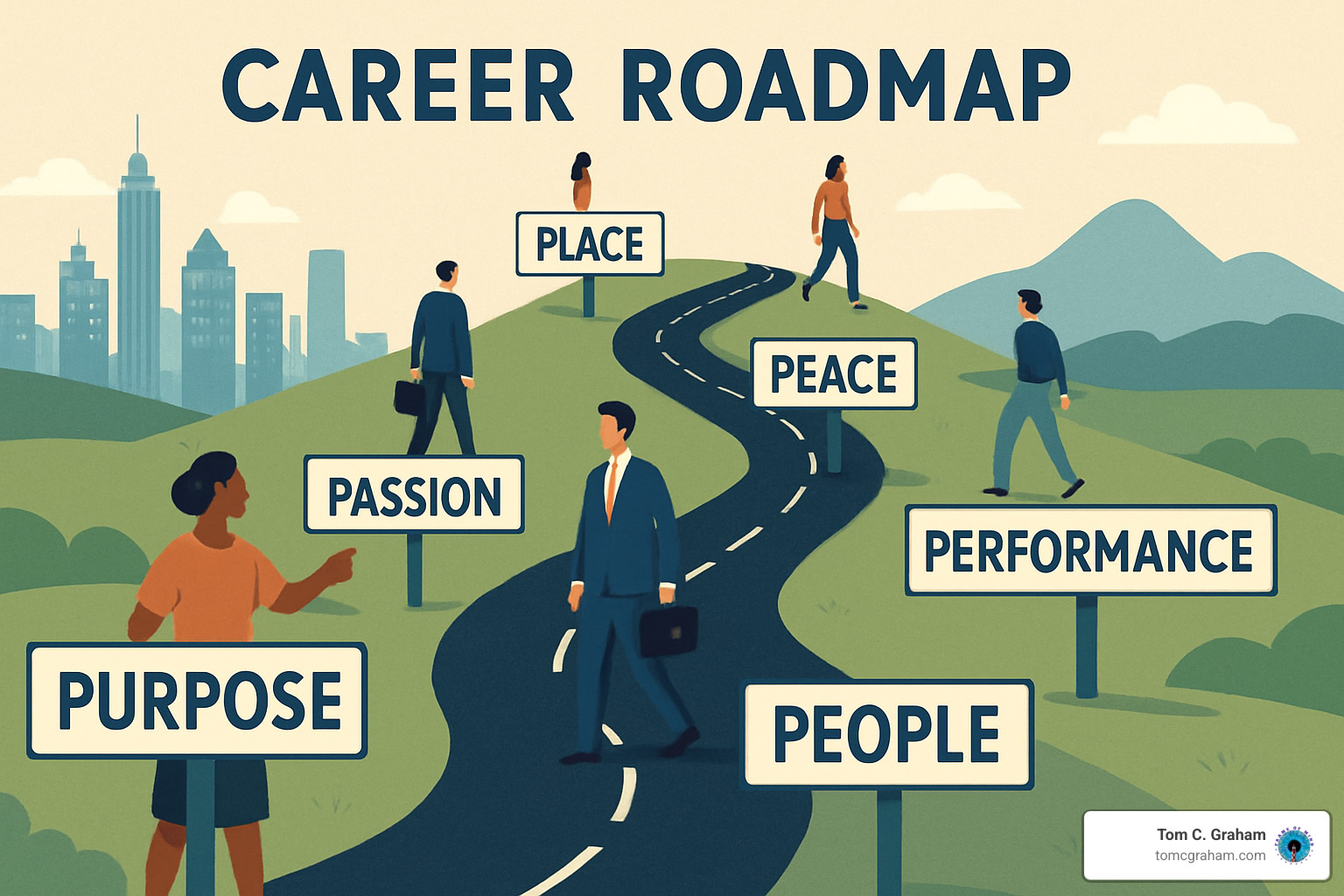
This framework complements the 7 P’s approach, recognizing that true values-driven career growth happens when we address all dimensions of our work lives: Purpose, Performance, Peace, Passion, Prosperity, People, and Place. For deeper insights into this holistic approach, check out more information about Frame of Mind insights.
Handling Misalignment & Risk Mitigation
Sometimes, despite your best intentions, you might find yourself in a work situation that fundamentally clashes with your values. It’s like wearing shoes that just don’t fit – eventually, the discomfort becomes unbearable.
If you’re facing temporary misalignment, try creating psychological boundaries to mentally separate yourself from work that conflicts with your values. Find outlets for expressing your values outside of work, perhaps through volunteering or personal projects. Building a support network of like-minded colleagues can also help you steer challenging times. Most importantly, set a timeframe for your situation with a clear exit plan – knowing there’s an end date makes difficult situations more bearable.
For more significant misalignment, preparation becomes crucial. Build a financial cushion covering 3-6 months of expenses before making major changes. Update your skills to increase your marketability in fields that better align with your values. Research organizations where you might be a better fit, and network strategically with professionals in those industries. Consider phased transitions – perhaps reduced hours or consulting work – as you make your move.
Burnout often results from values misalignment. When there’s a mismatch in workload, control, reward, community, fairness, or values, your emotional reserves deplete quickly. Listening to these warning signs can save you months or even years of unnecessary struggle.
Case Studies & Success Stories
Real stories bring values-driven career growth to life, showing us what’s possible when we align our work with what matters most.
Take Andrew, a 33-year-old electrical engineer earning an impressive six-figure salary but suffering from panic attacks, insomnia, and depression. Through careful values reflection, he realized his core values of work-life balance and ethical business practices were being violated daily in his current role. Despite accepting a modest pay cut, his transition to a utility company with clearer boundaries and more transparent practices dramatically improved his health and overall life satisfaction within months.
Organizations like 80,000 Hours exemplify the Effective Altruism approach, helping people maximize social impact through intentional career choices. By explicitly prioritizing impact as their #1 value, they’ve guided thousands of professionals toward high-impact careers in areas like AI safety research, global health, and policy reform – showing how values can serve as a powerful compass for career direction.
A fascinating study of 400 professionals in Pakistani small and medium enterprises revealed that employees with strong value-driven career attitudes demonstrated significantly higher job performance and organizational citizenship behaviors. This research confirms what many of us intuitively sense: when our work aligns with our values, everyone benefits – ourselves, our colleagues, and our organizations.
These real-world examples show us that values-driven career growth isn’t just an idealistic concept – it’s a practical approach that leads to better outcomes across the board. By taking thoughtful steps to align your career with your values, you’re not just creating a more fulfilling work life; you’re setting yourself up for sustainable success and wellbeing.
Building Values-First Cultures: Role of Leaders & Organizations
While individuals can drive their own values-driven career growth, organizations play a crucial role in creating environments where values alignment can flourish. Forward-thinking leaders understand that when employees’ values align with company culture, extraordinary things happen.
The Business Case for Values Alignment
The evidence for investing in values alignment isn’t just feel-good philosophy—it’s backed by compelling research.
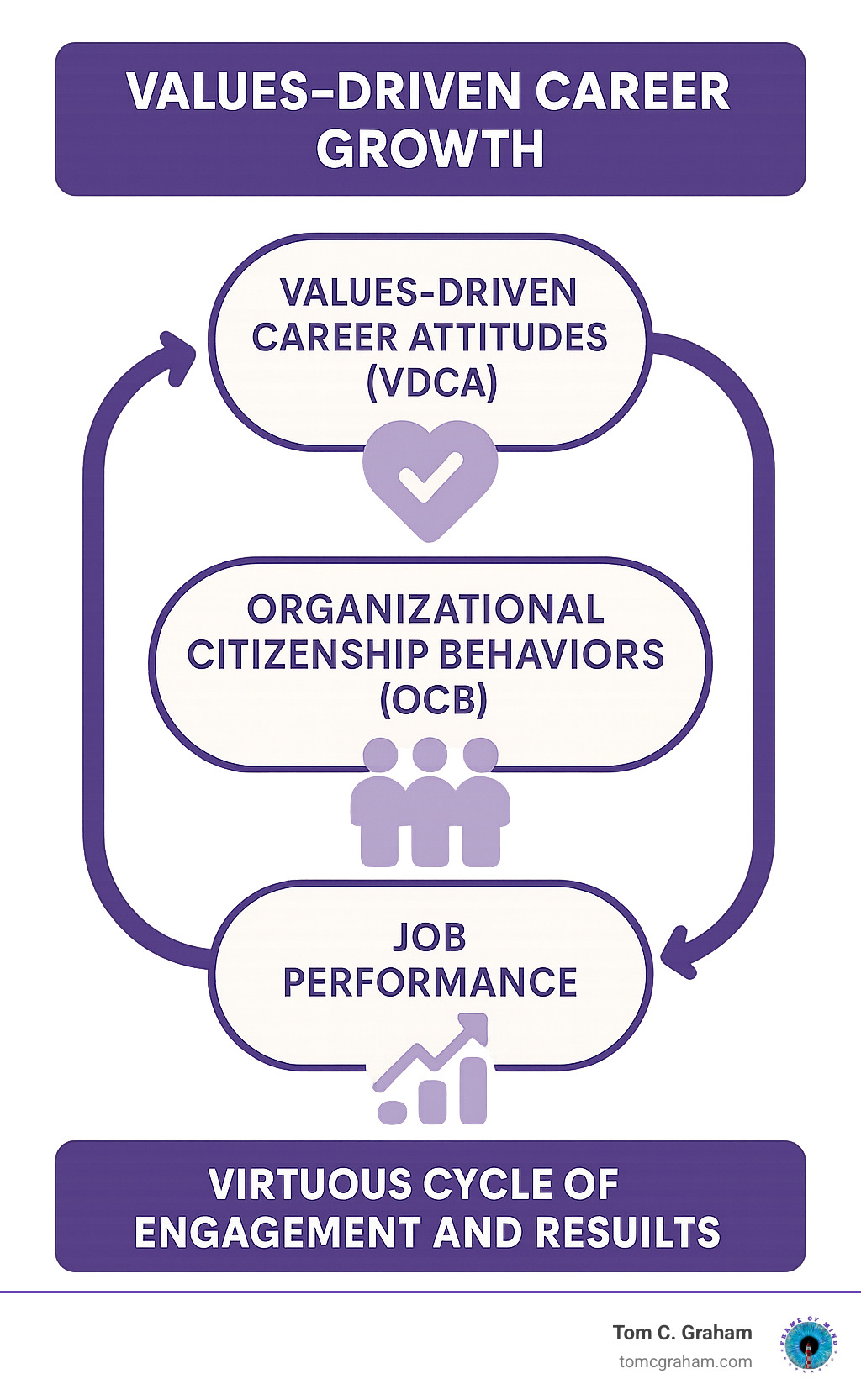
Organizations that prioritize values alignment see employees who go above and beyond their job descriptions. These organizational citizenship behaviors (OCB) naturally emerge when people feel their work reflects what matters to them personally. Studies show that employees with strong value-driven career attitudes consistently demonstrate higher job performance across industries.
The financial impact is equally clear. Burnout, often caused by values misalignment, costs businesses a staggering $322 billion globally in lost productivity and turnover. On the flip side, 71% of professionals report they’d actually take a pay cut to work for a company that shares their values—a powerful statement about what truly motivates today’s workforce.

Leaders who foster values alignment enjoy tangible benefits: higher retention rates as employees stay where they feel understood, increased innovation from engaged team members, stronger team cohesion, and ultimately, better business results.
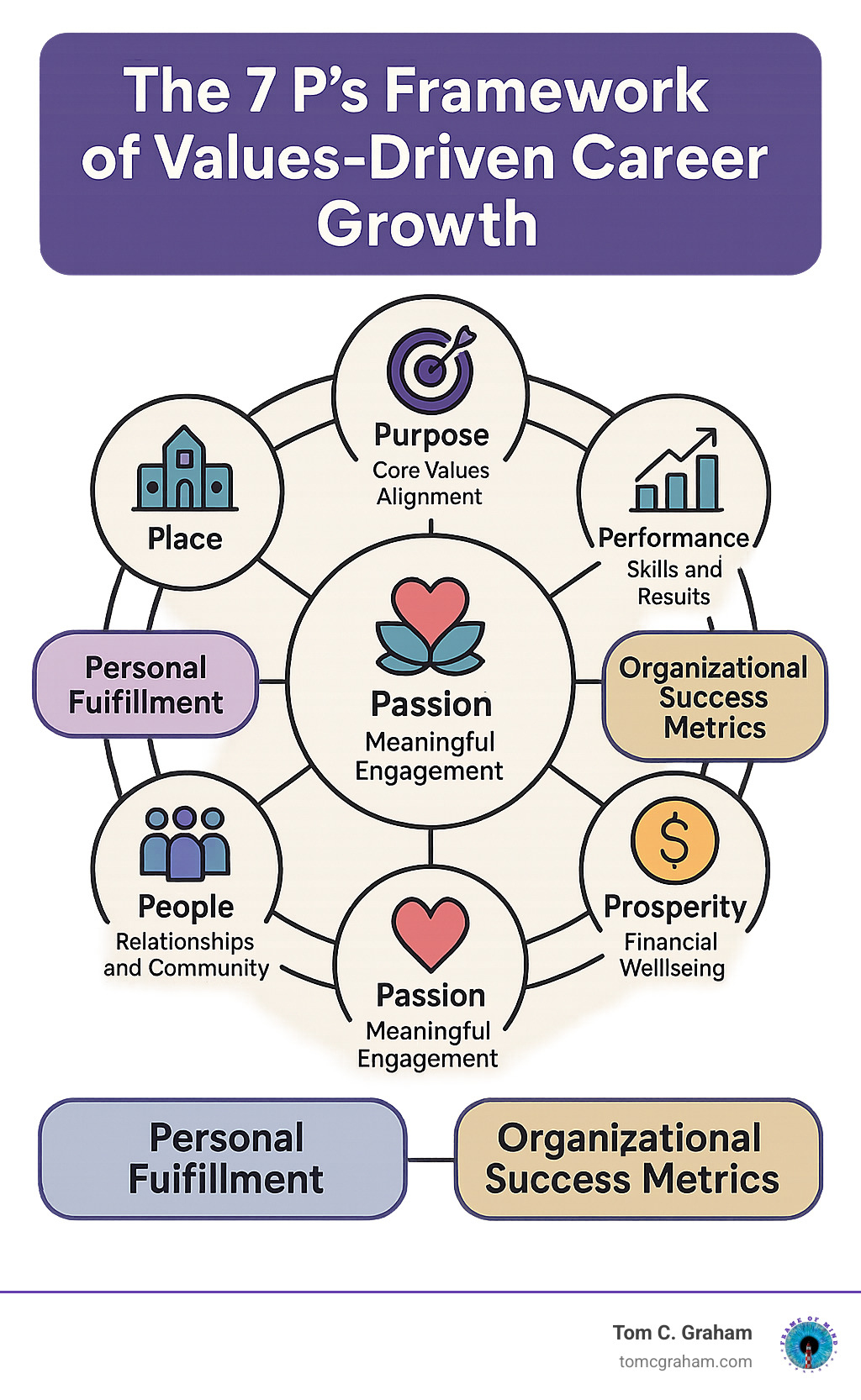
Our 7 P’s framework offers a holistic approach to integrating values across organizational systems. When Purpose (values) aligns with Performance expectations, Peace (well-being), Passion (engagement), Prosperity (rewards), People (relationships), and Place (environment), organizations create sustainable high performance. You can learn more about the 7 Ps framework here.
Metrics: From Well-Being to High Performance
“What gets measured gets managed” holds true for values-first cultures too. Smart organizations track progress through meaningful metrics at multiple levels.
At the individual level, this means monitoring employee engagement scores, value alignment self-assessments, and well-being indicators. Retention rates and career progression satisfaction provide longer-term insights into how well values alignment is working.
Teams thrive when psychological safety scores are high, allowing authentic expression of values. Collaboration effectiveness, innovation metrics, and team cohesion assessments reveal how well shared values translate into collective performance.
Organizationally, Net Promoter Scores (both customer and employee), employer brand strength, and productivity per employee all reflect the health of values alignment. Reduced absenteeism and presenteeism rates often signal that people find meaning in their work.
The key insight from scientific research on OCB and wellness is that values alignment creates a virtuous cycle: When employees’ values align with organizational culture, they naturally engage in more organizational citizenship behaviors, which in turn boost overall performance.
Supporting Employee Values Development
Creating a values-aligned organization doesn’t happen by accident. It requires intentional effort and specific practices.
First, make values explicit and actionable. Simply having values painted on a wall isn’t enough—organizations need to clearly articulate what these values look like in everyday behaviors. Recognizing and rewarding values-aligned actions reinforces their importance, while integrating values into performance discussions ensures they’re not treated as separate from “real work.”
Second, create development opportunities that honor diverse values. Learning stipends for values-related skill building allow employees to grow in directions meaningful to them. Career paths that accommodate different values—whether someone prioritizes innovation, service, stability, or leadership—ensure everyone can find their path forward.
Building a coaching culture represents another powerful approach. When managers are trained in values-based coaching approaches, conversations about purpose and meaning become normalized. Creating safe spaces for values exploration allows people to bring their whole selves to work.
Some quick-win actions organizations can implement include:
- Conducting values audits during organizational changes
- Implementing regular “values check-ins” in team meetings
- Creating values-based employee resource groups
- Offering paid time for community service aligned with values
- Designing flexible work arrangements to accommodate diverse life values
By implementing these practices, organizations create environments where employees can authentically express their values through their work. The result? Sustainable high performance paired with genuine fulfillment—a winning combination for both people and profits.
Frequently Asked Questions about Values-Driven Career Growth
What if my current role clashes with my values?
Feeling that disconnect between what you do and what you believe can be incredibly draining. If you’re experiencing this common challenge, here’s how to approach it thoughtfully:
Start by getting crystal clear about where exactly the clash is happening. Which of your values feels compromised? Is it something about your specific role, your team’s culture, or the broader organization? Sometimes pinpointing the exact friction point helps you see solutions more clearly.
Consider having a thoughtful boundary-setting conversation. Frame these discussions around how you can optimize your performance rather than lodging complaints. Try using “I” statements like, “I’ve noticed I deliver my best work when I can align tasks with my creativity.” This approach feels collaborative rather than confrontational.
If adjustments aren’t possible, it might be time to develop a transition plan. Give yourself a specific timeline—”I’ll try these adjustments for the next three months”—while beginning to explore other opportunities within your organization that might offer better alignment. Simultaneously, start building skills and networks for an external move if needed, and create some financial cushion to support a potential transition.
Some degree of compromise is normal in any role. The important question is whether the misalignment affects your core, non-negotiable values or more flexible preferences. Your peace of mind often depends on knowing the difference.
How do I negotiate for value-aligned benefits?
Many of us focus solely on salary during negotiations, missing valuable opportunities to advocate for benefits that honor what matters most to us. Values-driven career growth often means thinking beyond the paycheck.
If work-life balance tops your values list, consider negotiating for flexible schedules, remote work options, or additional paid time off. For those who prioritize learning and growth, request professional development budgets, conference attendance, or formal mentorship programs. If making an impact drives you, propose dedicated time for corporate social responsibility projects or community involvement.
The secret to successful negotiation is preparation. Research the organization’s stated values and existing benefits, then frame your requests as win-win opportunities. For instance: “I notice the company emphasizes innovation in its mission statement. I’ve found I’m most creative when I have dedicated exploration time. Could we discuss allocating 10% of my schedule to innovation projects that could benefit our department?”
This approach shows you’ve done your homework and are thinking about mutual benefit—not just personal gain.
Can values change over time, and how do I adapt?
Yes! Your values absolutely can—and often do—evolve throughout your career and life stages. This evolution isn’t a sign of inconsistency but of healthy growth.
Think of it this way: becoming a parent might suddenly lift “security” in your values hierarchy. A health challenge might bring “balance” to the forefront. A global crisis might awaken “community contribution” as a driving force. These shifts reflect your journey as a human being.
To steer these changes gracefully, schedule regular values check-ins with yourself, especially during major life transitions. Pay attention to what increasingly energizes or drains you at work—these shifts offer clues about your evolving values. Keep updating your personal values document as a living record of your growth.
Your core values might remain relatively stable, but how they express themselves often changes. For example, “growth” might stay important to you, but what growth looks like at 25 versus 45 could be dramatically different.
Values-driven career growth isn’t about rigidly sticking to a static set of principles—it’s about maintaining alignment between your evolving authentic self and your work. This dynamic approach keeps your career journey both meaningful and sustainable through life’s many chapters.
Conclusion
The journey toward values-driven career growth offers a refreshing alternative to conventional career paths that often lead to burnout and that sinking “how did I end up here?” feeling. When you build your professional life around what genuinely matters to you, you create something special – a career that nourishes rather than depletes you.
I’ve seen this change countless times with my clients. The research backs it up too: people who align their work with their core values consistently report greater satisfaction, deeper engagement, and better overall wellbeing. In today’s workplace, where change seems to be the only constant, your values serve as that reliable compass that keeps you oriented when everything else shifts.
Throughout this guide, we’ve walked through the essential elements of building a values-aligned career:
We’ve explored practical methods to uncover your authentic core values – those non-negotiable principles that define who you are. We’ve examined techniques for assessing how well your current role honors these values, and developed frameworks for making decisions that protect what matters most. We’ve looked at how organizations can create environments where diverse values can flourish, and tackled the very real challenges that arise when values clash with workplace realities.
This path isn’t always the easiest one. It requires genuine self-reflection, occasional difficult conversations, and sometimes making tough choices that others might not understand. But consider the alternative – spending most of your waking hours in work that contradicts your deepest values. That’s a far steeper price to pay in the long run.
At its heart, values-driven career growth is about integration – bringing your whole self to your work rather than compartmentalizing who you are from what you do. When your career reflects your values, work transforms from something you endure into a natural expression of your authentic self.
I encourage you to take one small step today. Identify a core value that matters deeply to you, and look for just one way to express it more fully in your work tomorrow. These aligned choices, made consistently over time, compound into something powerful – a career that grows without requiring you to compromise who you are along the way.
The 7 P’s framework we use helps clients find that sweet spot where performance and peace coexist, where purpose and prosperity reinforce rather than compete with each other. When these elements align, work becomes something altogether different – not just a job, but a pathway to your fullest self-expression.
Learn more about my approach to values-driven career development and how we might work together on your journey.