
Understanding Personal Fulfillment: The Foundation for a Meaningful Life
Personal fulfillment strategies are practical approaches to achieving a deep sense of satisfaction, purpose, and meaning in life. If you’re looking for ways to feel more fulfilled, here are the core strategies:
- Identify your core values and align your actions with them
- Set meaningful goals that connect to your authentic self
- Practice gratitude daily to appreciate what you have
- Balance work and personal life through clear boundaries
- Help others through service and positive relationships
- Accept yourself fully, including mistakes and imperfections
- Regularly reassess your path and adapt as needed
“The best day of your life is the one on which you decide your life is your own,” wrote Bob Moawad. This sentiment captures the essence of personal fulfillment—taking ownership of your journey rather than following someone else’s checklist.
Unlike happiness, which comes and goes with circumstances, fulfillment provides a steadier foundation. According to a 2021 Pew Research Center survey, 70% of Americans say that having a job or career they enjoy is essential to feeling fulfilled. Yet a 2018 Gallup poll found only 34% of U.S. workers feel engaged at work, highlighting the fulfillment gap many experience.
When you’re juggling career demands and family responsibilities, feeling fulfilled can seem like a distant dream. The truth is, fulfillment isn’t found in checking boxes like getting the promotion, buying the house, or reaching some future milestone. It emerges when your daily actions align with who you truly are and what genuinely matters to you.
True fulfillment persists even during life’s inevitable challenges. You might feel down sometimes, but with personal fulfillment strategies in place, you’ll have the internal resources to weather storms with resilience and purpose.
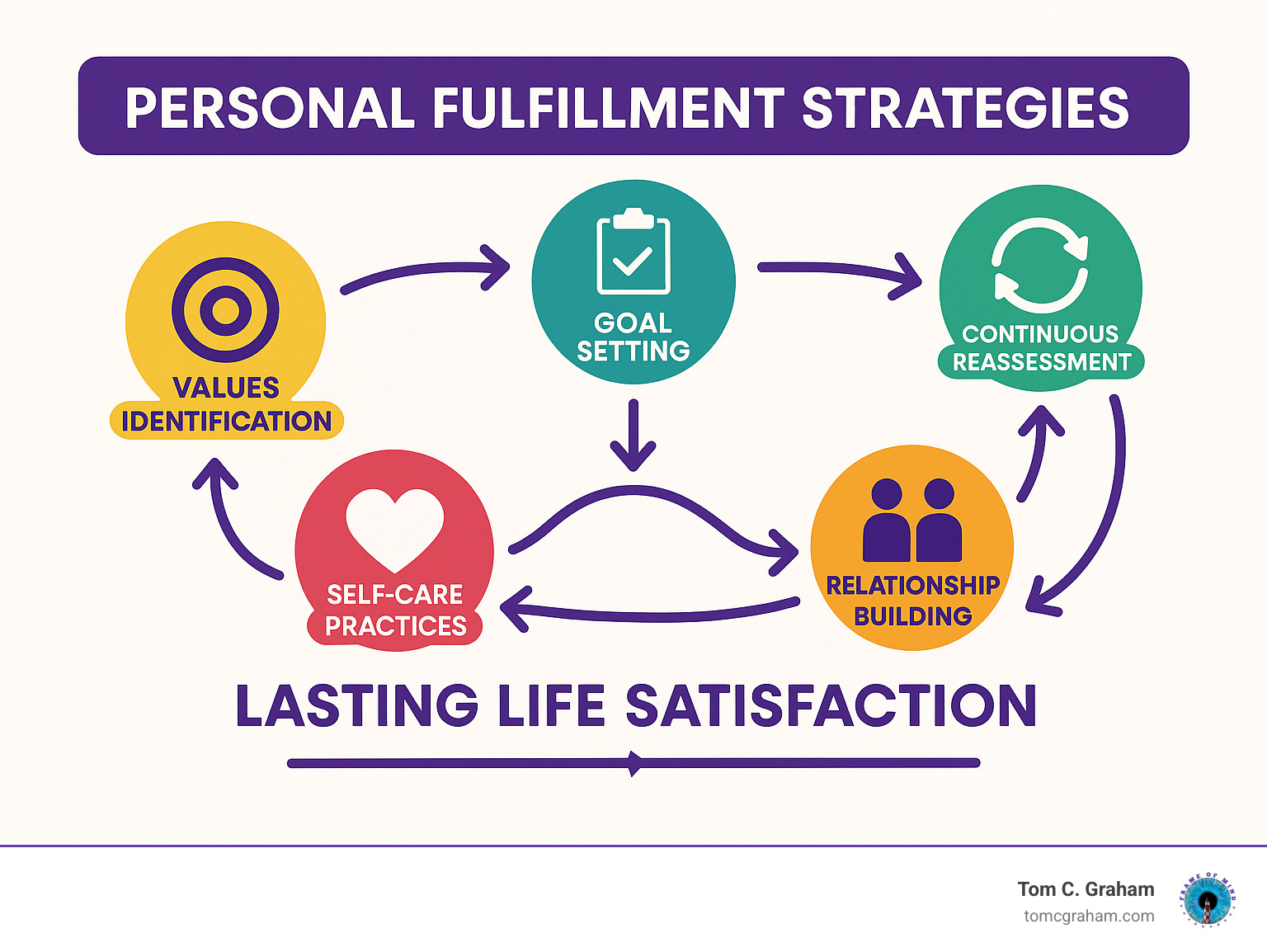
Fulfillment vs. Happiness—Knowing the Difference
Ever notice how the glow of a new purchase fades, but the satisfaction of living true to yourself seems to stick around? That’s the key difference between happiness and fulfillment—a distinction worth understanding as you develop your personal fulfillment strategies.
Happiness is that wonderful but fleeting emotional state psychologists call “hedonia.” It’s the spark of joy when you land a promotion, the delight of biting into your favorite dessert, or the thrill of a spontaneous trip. These moments brighten our lives but often slip through our fingers just as quickly as they arrive.
Fulfillment runs deeper. The ancient Greeks called it “eudaimonia”—a steady sense of well-being that comes from living meaningfully. When you’re fulfilled, you’ve built something more sustainable than a mood. You’ve created a life that reflects who you truly are and what genuinely matters to you.
| Happiness | Fulfillment |
|---|---|
| Temporary emotional state | Enduring sense of meaning |
| Based on external circumstances | Based on internal values alignment |
| Feels good in the moment | Provides ongoing satisfaction |
| Comes from pleasure and enjoyment | Comes from purpose and growth |
| Fluctuates frequently | Remains relatively stable |
| Can be passive (something happens to you) | Requires active engagement |
Why Fulfillment Outlasts Mood Swings
Think of fulfillment as the anchor that keeps you grounded when emotional storms roll in. As one researcher beautifully puts it, “With self-fulfillment, you often find peace within yourself, providing the steadiness to face life’s challenges.”
Being fulfilled doesn’t mean you’re walking around with a permanent smile. You’ll still experience the full spectrum of human emotions—from joy to frustration, excitement to disappointment. The difference is that these emotional waves don’t knock you off course because you’re connected to something deeper.
The 2021 Pew Research Center survey confirms what many of us intuitively know: people who find meaning in their work and relationships steer life’s inevitable bumps with greater resilience. They bend without breaking.
I often tell my clients that fulfillment works like a keel on a sailboat—it might be hidden beneath the surface, but it’s what keeps you stable when emotional winds pick up. You’ll still feel the waves, but you won’t capsize.
This stability doesn’t come from ignoring difficult emotions or pretending everything’s fine when it isn’t. Rather, it emerges when you’re living in alignment with your values and working toward goals that genuinely matter to you—even when that work isn’t always easy or immediately rewarding.
Find Your North Star: Values, Passion, Purpose
Developing effective personal fulfillment strategies begins with clarity about what truly matters to you. Think of your core values, passions, and purpose as your North Star—the fixed point that guides your journey even when life’s seas get choppy.

Have you ever noticed how some people seem to steer life with an inner compass that keeps them on track? That’s no accident. In Japanese culture, there’s a beautiful concept called “ikigai,” which translates roughly to “reason for being.” It’s that sweet spot where what you love, what you’re good at, what the world needs, and what you can be paid for all come together.
Finding your own version of ikigai isn’t just nice to have—it’s essential for deep fulfillment. A 2020 study in the Journal of Positive Psychology found that people who pursue personally meaningful goals are 42% more likely to report high levels of life fulfillment. Those aren’t just better odds—they’re life-changing ones.
At Tom C. Graham, we’ve seen how “life crafting”—actively designing your life around your values—transforms lives. This isn’t about letting life happen to you. It’s about grabbing the pen and writing your own story.
Unearthing Your Core Values
Values aren’t just concepts—they’re the invisible force behind your most important decisions. Unlike goals that you can check off a list, values are ongoing directions you live by. Whether you prize authenticity, connection, creativity, growth, or service, what matters is identifying the values that make your heart sing.
Here’s a simple exercise I often share with clients that yields powerful insights:
Find 30 minutes of quiet time and ask yourself these seven questions:
– What activities make you lose track of time?
– When do you feel most alive and energized?
– What would you do if money were no object?
– What accomplishments are you most proud of and why?
– What topics do you naturally find yourself reading or talking about?
– Who do you admire and what qualities do they embody?
– At the end of your life, what would you want to be remembered for?
Look for patterns in your answers—they’re signposts pointing toward your core values.
Another technique I love is mental contrasting—vividly imagining your ideal future and comparing it with your current reality. This creates a productive tension that not only motivates action but helps clarify what truly matters to you. It’s like creating a gap your mind naturally wants to fill.
Turning Passion Into Purpose
Values give you direction, but passion provides the fuel for your journey. I’ve seen too many people with passion but no purpose feeling like they’re spinning their wheels. Equally common are those with purpose but no passion who eventually burn out. What you’re aiming for is what psychologists call “harmonious passion”—activities you love that also contribute to your sense of meaning.
Start by getting honest about your strengths. What skills come naturally to you? What do others consistently compliment you on? When have you experienced those magical “flow” states where time seems to disappear? These aren’t random—they’re clues.
According to a 2019 LinkedIn survey, 74% of professionals believe having a sense of purpose at work drives personal fulfillment. But here’s the thing—this doesn’t mean you need to quit your job tomorrow to find your “dream career.” Often, it’s about finding ways to express your values and use your strengths in your current role.
As we guide clients through our 7 P’s framework, we emphasize that purpose typically emerges through action rather than endless contemplation. Start with what interests you, pay attention to what energizes you, and be willing to experiment. Your purpose will become clearer with each step forward—like a path that reveals itself as you walk.
Core Personal Fulfillment Strategies
Now that we’ve established the foundation of values, passion, and purpose, let’s explore the core personal fulfillment strategies that can transform your daily experience.
These strategies aren’t quick fixes or trendy life hacks—they’re authentic practices that, when woven into the fabric of your life, create lasting change. Think of them as building the infrastructure of a fulfilling life rather than occasional activities you check off a list.
Align Your Goals Using Personal Fulfillment Strategies
Have you ever achieved something you thought you wanted, only to feel strangely empty afterward? That’s what happens when our goals aren’t truly aligned with who we are. Many of us set goals based on what others expect or what society defines as success, then wonder why reaching them feels hollow.
The secret is setting what researchers call “self-concordant goals”—objectives that genuinely align with your intrinsic values rather than external pressures. The difference is remarkable: a 2020 study found people pursuing self-concordant goals reported 42% higher fulfillment levels than those chasing externally motivated achievements.
At Tom C. Graham, we recommend using the SMART-ER framework when setting goals:
– Specific: Crystal clear about what you want
– Measurable: You can track your progress
– Achievable: Realistic given your resources
– Relevant: Aligned with your core values
– Time-bound: Has a deadline to create momentum
– Exciting: Generates genuine enthusiasm (if it doesn’t, why bother?)
– Reviewable: Flexible enough to adjust as you grow

Life rarely unfolds in a straight line. Like sailing, you’ll often need to tack back and forth to reach your destination. That’s why monthly goal reviews are so powerful—they let you adjust your course while ensuring you’re still heading in the right direction. Think of these reviews as friendly check-ins with yourself rather than rigid performance evaluations.
Many clients find that “subconscious programming” supports their goal achievement beautifully. Create positive affirmations that align with your deeper aims and repeat them regularly. If deeper relationships matter to you, you might affirm: “I create meaningful connections through honest, open-hearted communication.” Simple, yes—but the mind responds powerfully to these consistent messages.
Personal Fulfillment Strategies Through Connection & Service
While self-development matters tremendously, the deepest fulfillment often comes through genuine connection with others and contribution to something larger than yourself. This isn’t just feel-good advice—it’s backed by science. A 2022 INSEAD Knowledge article notes that people who regularly practice gratitude report 23% higher levels of life satisfaction and fulfillment.
When we help others, something remarkable happens. Not only does the recipient benefit, but we experience what scientists call a “helper’s high” as endorphins and oxytocin flood our system. More importantly, service connects us to our shared humanity and weaves meaning into the fabric of our lives.
Service doesn’t require grand gestures. You might volunteer for causes that matter to you, mentor someone in your field, perform small acts of kindness, offer your professional skills pro bono, or simply be fully present for friends during tough times. What matters is the spirit behind your actions, not their scale.
The quality of our relationships stands as one of the strongest predictors of life satisfaction. Interestingly, it’s not about having a huge social circle—a few deep, authentic connections often provide more fulfillment than dozens of surface-level interactions. As one entrepreneur in our research noted, “True fulfillment today is about changing the world and leaving a legacy, not just profit.” Finding your unique way to make a positive difference creates purpose that transcends personal achievement.
Tech-Wise Practices for Personal Fulfillment Strategies
Our relationship with technology can either nurture or drain our sense of fulfillment. The key isn’t rejecting technology but making it serve your values rather than letting it hijack your attention and time.
Digital boundaries create space for what truly matters. Consider designating tech-free zones in your home where conversation and presence take priority. Use “Do Not Disturb” mode during personal time, and set specific windows for checking email and social media rather than responding to every ping.
Productivity apps can be powerful allies when chosen mindfully. Look for tools that genuinely align with your goals and values. Time-tracking apps can reveal surprising insights about how you actually spend your days (versus how you think you do). Meditation apps can support a regular mindfulness practice that builds present-moment awareness.
Mindful scrolling transforms how you engage with devices. Before picking up your phone, pause and ask: “Why am I doing this right now?” Set a timer when browsing social media to avoid the time-warp effect, and deliberately curate your feeds to include content that inspires and educates rather than depletes you.
A 2022 American Psychological Association survey found that 60% of adults who regularly practice self-care report higher levels of fulfillment. Technology can beautifully support this self-care through meditation guidance, fitness tracking, or simple reminders to take breaks and practice gratitude.
At Tom C. Graham, we encourage clients to conduct regular “digital audits” to ensure their technology use genuinely supports rather than undermines their deeper values. As we explore in our blog insights, technology works best when it improves our humanity rather than replacing it.
Navigating Barriers & External Influences
Even with clear values and solid personal fulfillment strategies, you’ll inevitably face obstacles on your journey. Let’s be honest—if finding fulfillment were easy, everyone would be living their best life already! Understanding and addressing these barriers is crucial for sustained fulfillment.
External influences—from societal expectations to family pressures—can pull you away from your authentic path like a strong current. Meanwhile, internal barriers like fear, self-doubt, and perfectionism can keep you stuck even when external conditions are favorable. Past trauma can also cast long shadows over your present efforts to find fulfillment.

Reframing Limiting Beliefs
Many barriers to fulfillment begin in the mind. Limiting beliefs—those pesky assumptions about yourself or the world that constrain your potential—often operate below the level of conscious awareness, like background music you’ve gotten so used to you don’t even notice it anymore.
You might catch yourself thinking: “I’m not good enough,” “It’s selfish to prioritize my own fulfillment,” or “I don’t deserve success.” These thoughts aren’t facts—they’re stories we tell ourselves, often inherited from childhood experiences or cultural messages.
The first step in overcoming these beliefs is bringing them into the light. Pay attention to your self-talk, especially when you feel stuck or hesitant. What assumptions are you making? What “truths” are you accepting without question?
Once identified, you can reframe these limiting beliefs using several techniques. Evidence examination helps you challenge your beliefs by looking for contradictory examples from your own life. If you believe “I always fail at new things,” recall times when you successfully learned something new—even small wins count!
Affirmations can be powerful when done right. Create statements that counter your limiting beliefs using present tense and positive language. Instead of “I will stop being afraid,” try “I am courageously taking small steps forward each day.”
The MCII method (Mental Contrasting with Implementation Intentions) combines positive visualization with practical planning. Imagine achieving your goal, identify potential obstacles, then create specific “if-then” plans to overcome them. For example: “If I feel overwhelmed by my project, then I’ll break it down into smaller tasks.”
Sometimes logic keeps us stuck in limiting beliefs. Learning to trust your intuition—your deeper knowing—can help you move past analytical paralysis and connect with your authentic desires.
Balancing Expectations and Authenticity
External expectations can feel like a heavy backpack you never asked to carry. The challenge is figuring out which expectations align with your authentic self and which are simply weighing you down unnecessarily.
Setting boundaries is essential for protecting your fulfillment journey. This doesn’t mean cutting people off or being unkind—it’s about clearly communicating your needs and limits with compassion. You might say, “I value our relationship, but I need to decline this request to honor commitments I’ve made to myself.”
Cultural scripts—those unwritten rules about how life “should” unfold—can be particularly challenging to steer. These might include expectations about education, career progression, relationships, or family formation. Recognizing these scripts allows you to consciously choose which to follow and which to rewrite according to your own values.
Courage plays a vital role in pursuing authentic fulfillment. As researcher Brené Brown notes in The Path to Unconditional Self-Acceptance, vulnerability—the willingness to be seen in your authentic truth—is the birthplace of connection, creativity, and meaningful change.
At Tom C. Graham, we help clients develop what we call “aligned courage”—the ability to take bold action that’s congruent with your deepest values, even when facing resistance or uncertainty. It’s not about being fearless; it’s about feeling the fear and moving forward anyway because what you’re moving toward matters deeply to you.
The path to fulfillment isn’t about eliminating all obstacles—it’s about developing the resilience and self-awareness to steer them while staying true to yourself. Sometimes the very barriers that seem to block our way become the stepping stones that lead us to deeper understanding and more authentic fulfillment.
Daily Habits, Technology & Continuous Reassessment
The magic of fulfillment isn’t found in grand, sweeping gestures—it’s woven into the fabric of your everyday choices. Like drops of water that eventually fill a bucket, it’s your daily habits that ultimately create the texture of your life.
Starting your day with intention sets a powerful tone. Whether it’s savoring a quiet cup of coffee before the household wakes, jotting thoughts in a journal, or moving your body with purpose—the specific morning activities matter less than the mindfulness behind them. When you begin each day aligned with what truly matters to you, everything that follows tends to fall into better alignment too.
Mindfulness deserves special mention here. This practice of being fully present without judgment has been shown to significantly boost well-being. The good news? Even five minutes of mindful breathing can center you in your values and help you respond thoughtfully rather than react impulsively to whatever the day brings.
Your body and mind are inseparable partners on this journey. Regular movement not only strengthens your physical health but literally changes your brain chemistry for the better. A fascinating 2020 study found that regular exercisers report 30% higher life satisfaction levels than their sedentary counterparts. That’s a pretty compelling return on investment for lacing up your sneakers!
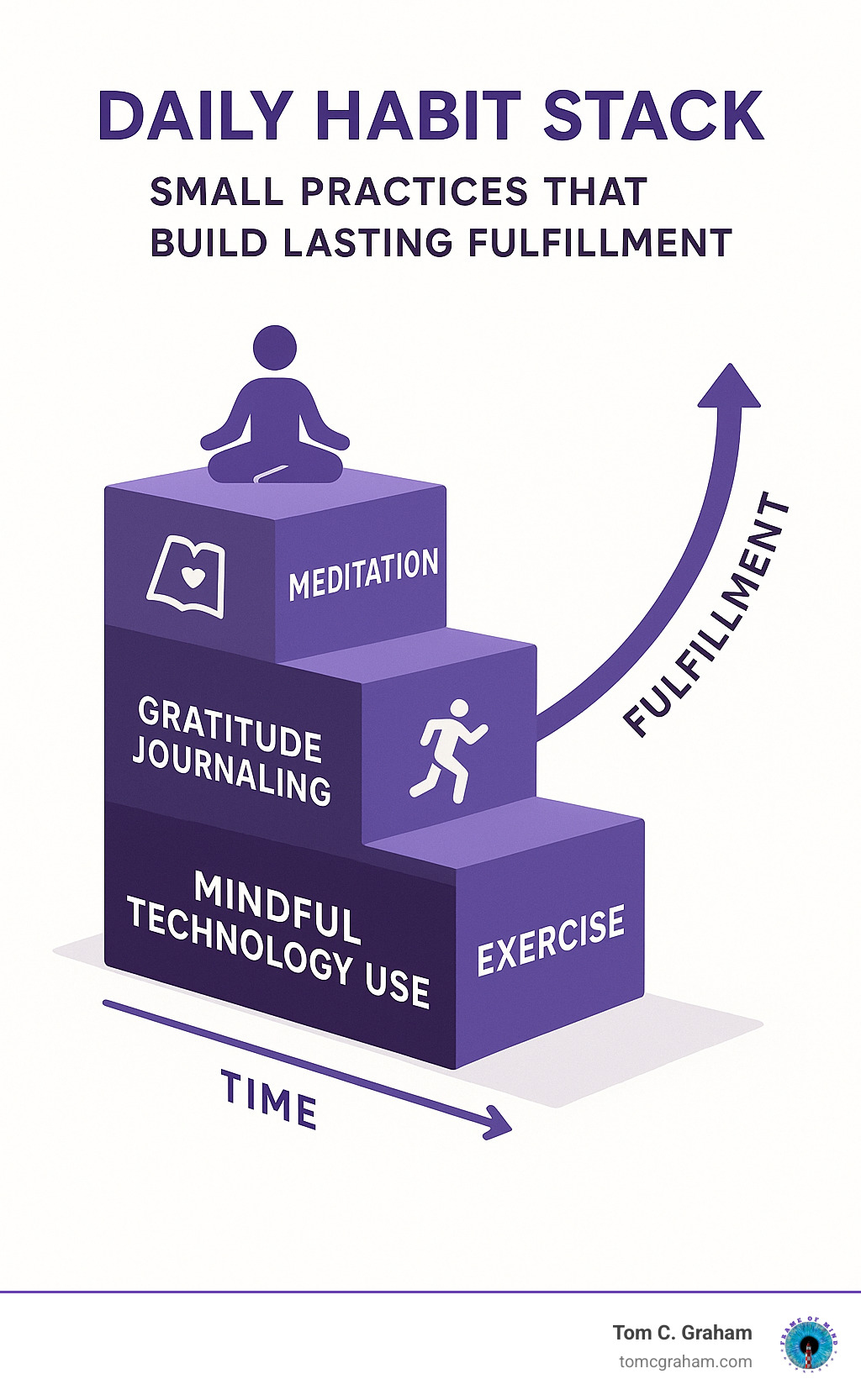
Few personal fulfillment strategies are as thoroughly researched and validated as gratitude practice. The simple act of writing down three things you appreciate each day gradually rewires your attention from what’s missing to what’s abundant in your life. This isn’t toxic positivity—it’s training your mind to notice the full picture rather than defaulting to the negative.
At Tom C. Graham, we guide clients through our 7 P’s framework to help them balance performance and peace in today’s demanding world:
- Purpose: Connecting to your deeper “why”
- Passion: Engaging with what genuinely energizes you
- Presence: Fully inhabiting each moment
- Productivity: Creating value efficiently and meaningfully
- Peace: Cultivating inner calm amid outer chaos
- Play: Embracing joy, creativity, and lightness
- Perspective: Maintaining the long view when daily pressures mount
To keep yourself honest and on track, schedule quarterly check-ins with yourself. Think of these as personal board meetings where you can reflect on your journey, celebrate progress (even small wins!), and make course corrections with compassion rather than criticism.
Micro-Practices That Move the Needle
Sometimes the smallest habits create the biggest shifts. These “micro-practices” take minimal time but yield remarkable benefits when done consistently.
Your breath is perhaps your most powerful and portable tool for wellbeing. The “4-7-8” breathing technique—inhale for 4 counts, hold for 7, exhale for 8—activates your body’s relaxation response in just 60 seconds. I’ve seen clients transform challenging meetings and difficult conversations with this simple practice.
Kindness doesn’t require grand gestures. “Five-minute favors” involve briefly helping others without expecting anything in return—making an introduction, sharing a helpful resource, or offering specific feedback. These small acts create ripples of connection and meaning without demanding significant time.
Don’t skip celebrating your wins! When you achieve a goal or milestone, take a moment to consciously acknowledge it. This might be as simple as a quiet “well done” to yourself or as festive as dinner with friends. These celebration rituals reinforce positive behavior and remind you that the journey itself matters, not just the destination.
Technology can be either a hindrance or a helper in your fulfillment journey. Choose tools that genuinely support your intentions—perhaps a meditation app that guides your practice, a habit tracker that provides gentle accountability, or simple reminder bells that prompt you to pause and breathe throughout your day.
Adapt, Iterate, Evolve
Personal fulfillment isn’t a fixed destination but a living, breathing journey. As you grow and life circumstances shift, your definition of fulfillment naturally evolves too.
Sometimes the bravest thing you can do is change direction. If a goal no longer resonates with your values or circumstances, pivoting isn’t failure—it’s wisdom. The flexibility to adjust course based on new information or insights is a strength, not a weakness.
What fulfilled you in your twenties might feel hollow in your forties. What energizes you during one career phase might drain you in another. Different life stages often call for different personal fulfillment strategies, and regular reassessment allows you to honor these natural evolutions without judgment.
Life follows what I call the resilience loop—challenge, growth, integration, new challenge. Rather than trying to avoid difficulties (which is impossible anyway), you can approach them as opportunities for expansion and deeper understanding. The obstacles often contain the greatest gifts.
As one client beautifully put it, “Life is a process of continuous learning—the moment you stop learning, you’re dead.” Maintaining curiosity and openness keeps your fulfillment journey vibrant and evolving. The questions you ask often matter more than the answers you think you need.
For a deeper dive into balancing performance demands with inner peace, explore The 7 Ps: Balancing Performance and Peace in a Demanding World, where we unpack these principles in greater detail.
Frequently Asked Questions about Personal Fulfillment Strategies
How often should I reassess my goals for fulfillment?
Life moves in seasons, and your fulfillment journey should reflect that natural rhythm. While there’s no perfect schedule that works for everyone, I’ve found that monthly check-ins work wonderfully for short-term goals, with deeper quarterly reviews for those bigger life objectives.
Think of these check-ins like regular maintenance for your car—they prevent small issues from becoming major problems. During particularly significant life transitions—whether you’re changing careers, starting or ending relationships, or moving to a new city—these moments naturally invite deeper reflection.
What matters most isn’t the exact timing but the consistency. Some of my clients prefer weekly reflections in their journals, while others find quarterly reviews give them the perfect balance of perspective and practicality. The key is finding your own rhythm that provides enough structure without becoming another box to check.
Reassessment doesn’t always mean changing direction. Often, these reflections simply confirm you’re on the right path, perhaps with a few tweaks to your pace or approach rather than a complete overhaul of your destination.
Can personal fulfillment strategies coexist with a demanding career?
Not only can personal fulfillment strategies coexist with a demanding career—they become absolutely essential when work consumes significant time and energy. The secret lies in integration rather than separation.
Start by connecting the dots between your work and your deeper values. Even in the most demanding roles, fulfillment emerges when you recognize how your work contributes to others, allows you to use your natural strengths, or provides resources for what truly matters in your life.
I’ve seen countless professionals transform their relationship with work by setting clear boundaries—designating specific times when they’re truly “off the clock” and honoring these consistently. Even on the busiest days, finding micro-moments to connect with your values makes a difference—perhaps through a brief moment of gratitude before a meeting or a conscious act of kindness toward a colleague.
If your work heavily engages one part of your personality, seek balance through complementary activities. Analytical professionals often find tremendous fulfillment in creative hobbies, while those in people-intensive roles might cherish periods of solitude and reflection.
A 2019 LinkedIn survey revealed that 74% of professionals believe having a sense of purpose at work is a key driver of personal fulfillment. This suggests that finding meaning within your career, rather than trying to separate work from fulfillment, creates the most sustainable approach to a well-lived life.
What if external pressures conflict with my authentic path?
This might be the most common challenge I hear from clients—that tension between what others expect and what feels genuinely right for you. It’s the classic fulfillment dilemma, and navigating it requires both compassion and courage.
Start by getting crystal clear about the specific conflict. What exactly is the external pressure you’re facing, and how does it clash with your authentic desires? Then honestly examine the consequences—both if you honor your authentic path and if you yield to external expectations. Consider the short-term relief versus the long-term costs to your sense of self.
Often, creative compromises exist that aren’t immediately obvious. I’ve watched clients find surprising ways to honor both external responsibilities and their deeper values once they stop seeing the situation as an either/or proposition.
When compromise truly isn’t possible, make your choice consciously rather than defaulting to external pressure out of habit or fear. Own your decision either way, knowing that authentic living sometimes requires disappointing others.
If your path disappoints people who matter to you, communicate with both honesty and empathy. Acknowledge their feelings while standing firm in your truth. As one client beautifully put it: “I can respect your disappointment while still honoring my truth.”
Fulfillment doesn’t require rejecting all external influences. The goal is developing discernment—the wisdom to distinguish between expectations that align with your authentic self and those that don’t. This discernment is a muscle that strengthens with practice, becoming more reliable as you continue your fulfillment journey.
Conclusion
The journey toward personal fulfillment is perhaps the most important work of your life. It’s not about crafting a resume that impresses others, but creating a life that resonates deeply with your authentic self.
Throughout this guide, we’ve seen how effective personal fulfillment strategies begin with understanding what truly matters to you. Your values, passions, and purpose serve as the compass for meaningful living. When you know your North Star, you can align your goals, build supportive habits, steer obstacles with grace, and regularly reassess your direction.
At Tom C. Graham, our 7 P’s framework offers a holistic approach to finding balance in our demanding world. We’ve finded that genuine fulfillment rarely comes from ticking boxes on society’s checklist. Instead, it emerges naturally when your daily choices reflect your deepest values and authentic self.
Adopting a legacy mindset can transform how you approach each day. Ask yourself: “When I’m gone, what will have mattered most about how I lived?” This question cuts through the noise and helps you focus on what’s genuinely important. The answer becomes your guide for today’s decisions, not just tomorrow’s ambitions.
Staying curious keeps your fulfillment journey fresh and evolving. When you accept continuous learning, you remain open to new perspectives and willing to challenge your own assumptions. As Socrates wisely noted, “The unexamined life is not worth living.” Regular self-reflection isn’t just philosophical—it’s practical.
Interestingly, service to others isn’t separate from personal fulfillment—it’s a cornerstone of it. When you contribute to something beyond yourself, whether through your career, relationships, or community involvement, you tap into a wellspring of meaning that transcends individual achievement. This connection to something larger than yourself provides a sense of purpose that material success alone never can.
Your path to fulfillment belongs uniquely to you. The strategies we’ve shared aren’t rigid prescriptions but flexible tools to adapt to your specific circumstances and aspirations. Your journey won’t look exactly like anyone else’s—and that’s exactly as it should be.
I invite you to begin or continue your fulfillment journey with both intention and courage. The path isn’t always smooth, but it’s invariably worthwhile. As you gradually align your daily actions with your core values, you’ll find that fulfillment isn’t something you stumble upon—it’s something you consciously create, one authentic choice at a time.
Looking to deepen your understanding of balancing performance and peace? Learn more about our 7 P’s framework and how it can transform your approach to personal fulfillment.