
Understanding Personal Development Strategy: The Foundation for Growth
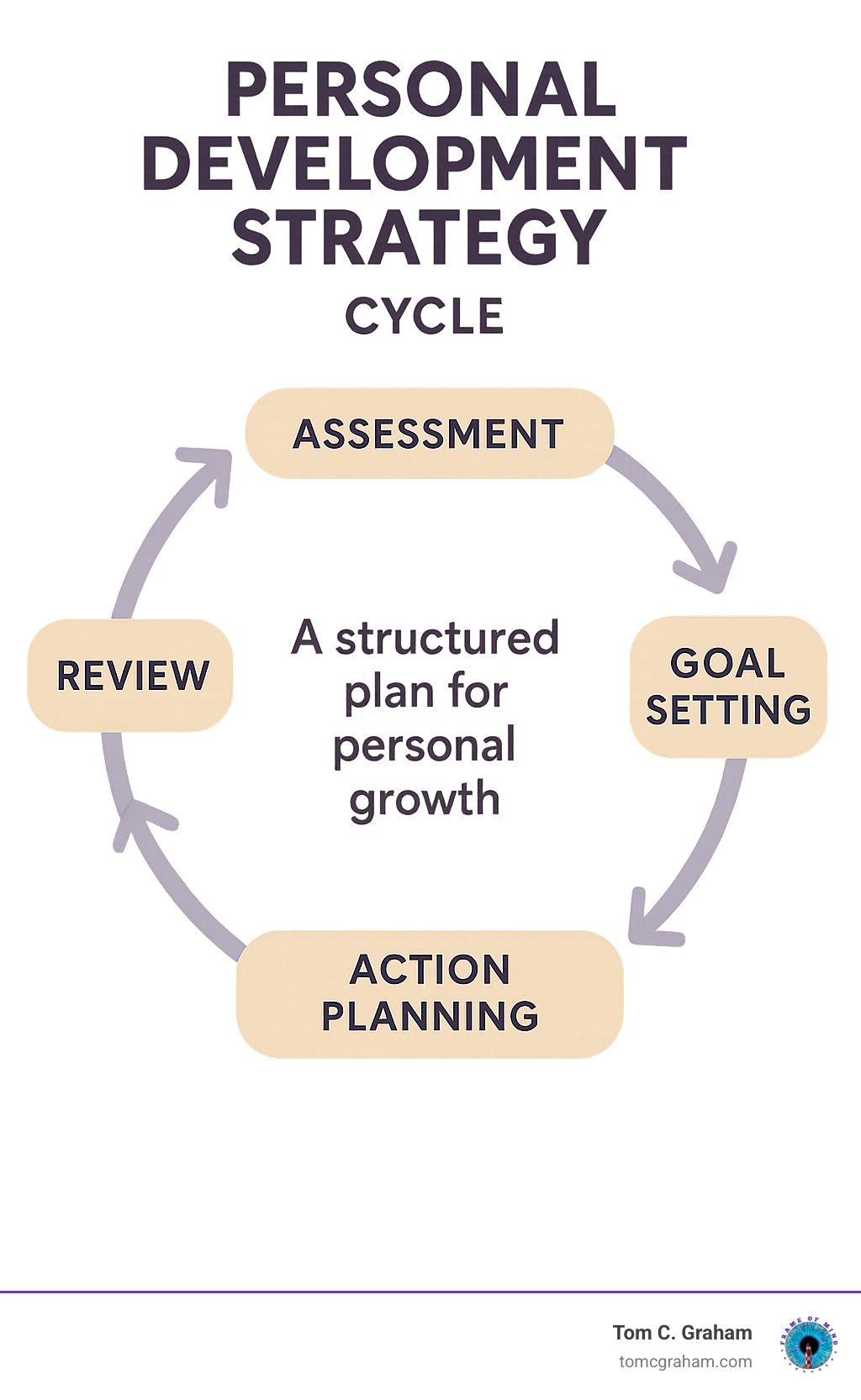
A personal development strategy is a structured plan that helps you identify your goals, strengths, and areas for improvement to create a roadmap for personal growth. For busy professionals seeking balance and fulfillment, here’s what you need to know:
What is a Personal Development Strategy?
– A written plan outlining your vision, goals, and action steps
– A framework for continuous improvement across all life areas
– A method to track progress and maintain accountability
– A tool to align daily actions with long-term aspirations
The road to becoming your best self isn’t accidental—it’s intentional. As Alan Lakein wisely noted, “Planning is bringing the future into the present so that you can do something about it now.”
In today’s demanding world, feeling overwhelmed by work and family responsibilities is common. A personal development strategy acts as your compass, helping you steer life’s complexities with purpose and direction.
Research shows that writing down your goals increases your chances of achieving them by up to 42%. But a true personal development strategy goes beyond just listing goals—it creates a systematic approach to becoming the person you want to be.
Why Personal Development Matters
Personal development isn’t a luxury or a trend – it’s the foundation for living a life that feels genuinely yours. When we actively invest in our growth, we stop being passengers in our own lives and grab the steering wheel instead.
What Is Personal Development and Why Is It Important?
At its heart, personal development is the ongoing journey of becoming more fully yourself. It’s about developing deeper self-awareness about who you are and what matters to you, clarifying your values, and committing to continuous improvement in all areas of life.
When you invest in yourself, you develop greater adaptability to steer our ever-changing world. You experience increased life satisfaction because you’re moving toward what truly matters to you. Your relationships naturally improve as you bring your healthier, more self-aware self to every interaction.
Perhaps most importantly, personal development builds resilience – that inner strength that helps you bounce back when life inevitably knocks you down.
Science-Backed Benefits of Growing Yourself
The beauty of personal development is that its benefits aren’t just philosophical – they’re backed by solid research:
Working on yourself leads to improved goal attainment. When you set specific goals and track your progress, you dramatically increase your chances of achieving them.
The connection between personal growth and increased happiness is well-established in positive psychology research. Simple practices like gratitude and mindfulness contribute significantly to your overall sense of wellbeing.
Personal development practices help with stress reduction too. Regular meditation and journaling have been shown to lower cortisol levels in the body, helping you stay calmer under pressure.
Your brain physically benefits through improved neuroplasticity. When you learn new skills and challenge yourself, you create new neural pathways that keep your brain healthy and adaptable as you age.
Research published in the National Library of Medicine shows that regular journaling improves the self-regulation needed to achieve long-term goals.

Crafting Your Personal Development Strategy
Building your personal development strategy isn’t about drafting a wishlist that collects dust—it’s about designing a roadmap that guides your journey toward becoming your best self.
Think of your strategy as the GPS for your personal growth journey. Without it, you might wander aimlessly or take unnecessary detours. With it, you’ll have a clear direction, even when life throws unexpected curves your way.
Before diving into specific goals, it helps to understand the different types of development you might focus on:
| Type | Focus | Primary Goal | Example Activities |
|---|---|---|---|
| Personal Development | Overall life satisfaction and balance | Becoming your best self across all life domains | Journaling, meditation, goal-setting |
| Professional Development | Career advancement and work skills | Improving job performance and career prospects | Courses, networking, mentorship |
| Personality Development | Character traits and behaviors | Enhancing specific aspects of your character | Communication training, emotional intelligence work |
Setting SMART & Stretch Goals
The backbone of any effective personal development strategy is thoughtful goal-setting.
When crafting your goals, think SMART:
- Specific: “I want to be healthier” becomes “I will walk 10,000 steps daily”
- Measurable: Include numbers or clear indicators of progress
- Achievable: Challenging but possible (be honest with yourself here!)
- Relevant: Aligned with your values and bigger life vision
- Time-bound: Set a deadline that creates healthy urgency
Don’t forget to include stretch goals too—those ambitious targets that make your heart beat a little faster. They should feel slightly uncomfortable but not impossible.
Research from Dominican University found that simply writing down your goals makes you 42% more likely to achieve them. Share those goals with a friend or mentor, and your chances skyrocket even higher.
Assessing Strengths and Gaps
Before mapping your destination, you need to know your starting point. A thorough self-assessment is the foundation of your personal development strategy.
Take some quiet time to reflect on these questions:
– What natural talents do people compliment you on?
– Which skills have you developed that serve you well?
– Where do you consistently struggle or feel stuck?
– What feedback have others given that surprised you?
You can deepen your self-knowledge through:
- Self-reflection through regular journaling or meditation
- 360-degree feedback from people who see different sides of you
- Personality assessments like StrengthsFinder or the Big Five
- Skills inventory where you honestly rate your abilities in different areas
Building Your Own Personal Development Strategy Blueprint
With clear goals and honest self-assessment in hand, you’re ready to create your personal development strategy blueprint—a master plan that brings everything together.
Your blueprint should include:
- Your vision statement—a vivid description of your ideal future
- Your mission statement—the purpose that guides your actions
- Your core values—the non-negotiable principles that guide your decisions
- Key focus areas—the 3-5 life domains where you’ll concentrate your growth efforts
- SMART goals for each focus area, with clear action steps and timelines
- Accountability measures—how you’ll track progress and stay committed
The Seven Essential Levers of Growth
After working with hundreds of clients at Tom C. Graham, I’ve noticed that true change happens when certain key elements work together. Think of these seven levers as the essential ingredients in your personal development strategy.
Mindset & Motivation: The Engine of Change
Your mindset is like the foundation of a house – everything else builds upon it. When psychologist Carol Dweck introduced the concept of a growth mindset, she revealed something powerful: believing your abilities can improve through effort completely transforms how you approach challenges.
Cultivating this growth-oriented thinking means embracing challenges rather than avoiding them. It means seeing setbacks not as failures but as valuable feedback.
What drives you matters just as much as what you believe. I’ve seen how intrinsic motivation (the internal satisfaction of accomplishment) creates lasting change, while extrinsic rewards (like money or praise) often fizzle out quickly.
Try visualization – spending a few minutes each day mentally rehearsing success programs your brain to recognize opportunities. Positive affirmations might feel awkward at first, but they genuinely help reinforce helpful beliefs.
Habit & Routine Design for Everyday Momentum
I love what James Clear says in “Atomic Habits” – tiny changes, remarkable results. Your daily habits are the invisible architecture of your life, shaping who you become without you even noticing.
The real power comes from identifying your keystone habits – those that create positive ripple effects across your life. For many of my clients, a consistent morning routine becomes this keystone, setting the tone for their entire day.
Environment design is another game-changer. Want to read more? Keep books on your nightstand instead of your phone. Looking to eat healthier? Make nutritious options visible and accessible.
The weekly review might be the most underrated habit of all. Taking 30 minutes each week to reflect on what’s working and what isn’t allows you to course-correct before small issues become major obstacles.
Skill Acquisition & Lifelong Learning
The most successful people I work with share one trait: they’re perpetual students. They understand that in today’s rapidly changing world, continuous learning isn’t optional – it’s essential for thriving.
Rather than passively consuming information, try active recall – testing yourself on material to strengthen neural connections. Spaced repetition – reviewing information at increasing intervals – dramatically improves retention compared to cramming.
Make learning non-negotiable in your personal development strategy. Even 15-30 minutes daily reading, taking courses, or practicing a skill compounds dramatically over time.
Health Foundations: Sleep, Exercise, Nutrition
Your body is the vehicle that carries you through life – neglect it, and everything else suffers. I’ve seen brilliant personal development strategies derailed simply because someone ignored their physical wellbeing.
Sleep might be the most undervalued productivity hack available. Those 7-9 hours aren’t a luxury – they’re when your brain consolidates learning and your body repairs itself.
Exercise doesn’t require a gym membership or marathon training. A daily 20-minute walk in nature delivers remarkable benefits for mood and creativity.
With nutrition, small sustainable shifts beat dramatic overhauls every time. Focus on adding good things (like an extra serving of vegetables) rather than just eliminating “bad” foods.
Relationships & Support Systems
No one succeeds alone. Your connections profoundly impact your growth, providing feedback, accountability, inspiration, and support.
Mentorship creates shortcuts to growth – 97% of mentees report their experience as valuable, with over half saying it significantly contributed to their success. A good mentor has walked the path you’re on and can help you avoid common pitfalls.
Your peer group subtly shapes your standards and expectations. As Jim Rohn said, you become the average of the five people you spend the most time with.

Overcoming Obstacles & Maintaining Momentum
Even the most thoughtfully crafted personal development strategy will hit some bumps along the way. That’s not a failure; it’s just part of the journey. The difference between those who achieve lasting growth and those who don’t often comes down to how they handle these inevitable challenges.
Common Roadblocks to Your Personal Development Strategy
When we work with clients at Tom C. Graham, we’ve noticed certain obstacles appear time and again. Recognizing these potential roadblocks in advance helps you prepare for them rather than being surprised when they emerge.
That nagging fear of failure might be the first thing holding you back. It’s completely natural—our brains are wired to protect us from potential disappointment. But remember, growth requires experimentation, and those “failures” actually provide your most valuable feedback.
Many people also struggle with lack of clarity about what they truly want. When your goals feel fuzzy or seem to conflict with each other, consistent progress becomes nearly impossible.
Are you feeling overwhelmed just thinking about all the changes you want to make? That’s decision fatigue and overwhelm talking. Your mental energy is a finite resource, and trying to transform everything at once is a recipe for burnout. Instead, simplify by focusing on just one or two key areas at a time.
Then there’s the reality of limited resources—whether that’s time, money, or support. These constraints can feel like immovable roadblocks, but they often spark creativity. What alternative approaches might work within your current limitations?
Perhaps the trickiest obstacle is self-sabotage—those moments when you seem to undermine your own best efforts. This often shows up as procrastination or making choices that directly conflict with your stated goals.
Tactics to Stay Consistent and Motivated
Maintaining momentum isn’t about heroic bursts of effort—it’s about sustainable strategies that keep you moving forward day after day. Here are some approaches we’ve found particularly effective:
Make it a habit to celebrate wins, no matter how small they might seem. This positive reinforcement builds motivation naturally and reminds you that you’re making progress.
When you need a motivational boost, try a 30-day challenge. There’s something magical about committing to a specific habit or skill for just one month. The time-bound nature creates urgency, and you’ll often see visible results that inspire you to continue.
Journaling might sound simple, but it’s a powerful tool for maintaining momentum. Taking even five minutes daily to reflect on your experiences helps you process challenges, extract valuable lessons, and maintain awareness of your growth journey.
Finding an accountability partner can make all the difference when motivation inevitably wanes. Share your goals with someone who will check in on your progress and offer support when things get tough.
Set aside time for quarterly reviews of your personal development strategy. These regular check-ins allow you to assess what’s working, adjust what isn’t, and renew your commitment to your most important goals.
Prepare for obstacles by creating fallback plans with “if-then” scenarios. For example, “If I miss my morning workout, then I’ll take a 15-minute walk during lunch.” These pre-made decisions eliminate the need to summon willpower in the moment.
Tracking Progress & Iterating Your Plan
A personal development strategy is only as effective as your system for tracking progress and making adjustments. Without measurement, it’s difficult to know whether you’re moving in the right direction or simply spinning your wheels.

Tools & Templates for Measurement
Think of tracking your growth like tending a garden – you need to regularly check in to see what’s flourishing and what needs extra attention.
Habit trackers can be wonderfully simple yet powerful tools. Whether it’s a paper calendar where you mark an X for each day you meditate, or a digital app that pings with reminders, these visual cues build momentum.
Many of our clients at Tom C. Graham find journaling to be transformative. Try setting aside just 10 minutes at the end of your day with prompts like “What energized me today?” or “Where did I step outside my comfort zone?”
For the more analytically-minded, tracking specific Key Performance Indicators brings clarity to your journey. Rather than vaguely hoping to “get healthier,” you might track your weekly workout consistency, water intake, or hours of sleep.
Weekly scorecards offer a bird’s-eye view of your life balance. Imagine rating each key area (relationships, health, career, etc.) on a simple 1-10 scale every Sunday evening.
If you’re looking for structure without reinventing the wheel, several free templates can jumpstart your tracking system:
– The 7 P’s Framework Template (available through Tom C. Graham)
– The One-Page Personal Development Plan
– The Quarterly Goal Tracker
– The Habit Stacking Worksheet
– The Weekly Review Template
When and How to Pivot Your Personal Development Strategy
Your personal development strategy shouldn’t be carved in stone. Life changes, you evolve, and your plan should too. Think of it as a GPS that recalculates when you take an unexpected turn – flexibility is a feature, not a bug.
There are natural inflection points when pivoting makes sense. Achieving a major goal creates space for new aspirations – take time to celebrate before setting fresh challenges.
Life transitions often necessitate strategy shifts. A new baby, relationship change, or career pivot reshuffles your priorities and available resources.
When you encounter persistent obstacles despite consistent effort, it might be time to try a different approach. As Einstein reportedly said, insanity is doing the same thing repeatedly and expecting different results.
Significant feedback from trusted sources deserves attention. We all have blind spots, and sometimes a mentor or coach can see possibilities (or problems) that we’ve missed entirely.
Perhaps most exciting is when you’ve outgrown your current plan. Goals that once seemed ambitious become routine, indicating it’s time to raise the bar.
At Tom C. Graham, we recommend quarterly check-ins for minor tweaks and annual deep reviews for significant strategy revisions. This balanced approach provides both stability and flexibility – like a tree with deep roots and branches that sway with the wind.

Frequently Asked Questions About Personal Development Strategy
How often should I review my personal development strategy?
Think of your personal development strategy like tending a garden—it needs different levels of care to truly flourish.
For daily growth, I recommend a quick 5-minute check-in with your top priorities and habits. This keeps your goals front of mind and helps you stay on track with small, consistent actions.
Weekly, set aside 30-60 minutes for a more thoughtful review. This is your chance to celebrate wins, identify challenges, and adjust your plan for the coming week.
Monthly reviews (1-2 hours) help you assess your habit consistency and progress on short-term goals. Are your daily actions adding up? Where might you need to make adjustments?
Quarterly, block 2-3 hours for a deeper dive. This is where the magic happens—you can spot patterns, evaluate medium-term goals, and make meaningful strategy adjustments based on what you’ve learned.
Finally, your annual review is like stepping back to admire your entire garden. Set aside a half-day to reconnect with your vision, values, and long-term direction.
What’s the difference between personal, professional, and personality development?
These three growth paths often intertwine like branches of the same tree, but understanding their distinctions can help you create a more balanced personal development strategy.
Personal development is the trunk of the tree—it supports everything else. It encompasses your growth as a complete human being across all life domains. When you meditate regularly, read widely, improve your financial literacy, or work on better work-life balance, you’re engaged in personal development.
Professional development focuses specifically on your career journey. Think of it as a major branch dedicated to your work life—developing leadership skills, earning certifications, mastering new technologies, or building industry expertise.
Personality development concentrates on refining who you are and how you show up in the world. This branch involves enhancing specific character traits and interpersonal skills—becoming a better communicator, developing emotional intelligence, cultivating patience, or growing more confident in social situations.
How can mentorship accelerate my growth journey?
Finding the right mentor is like finding a shortcut through a dense forest—suddenly, the path forward becomes clearer and more navigable.
A good mentor accelerates your growth in ways that self-study simply can’t match. They share hard-won wisdom that might have taken you years to find on your own. I’ve seen clients make remarkable leaps forward when they find someone who’s already walked the path they’re on.
Mentors also help you spot blind spots in your thinking and opportunities you might have missed. They’re standing on a different vantage point and can see things you can’t from your position.
The accountability factor shouldn’t be underestimated either. Knowing you’ll be discussing your progress with someone you respect creates powerful motivation to follow through on your commitments.
The research backs this up—97% of mentees report finding their mentorship experience valuable, with more than half believing it significantly contributed to their success.

Conclusion
Creating and implementing a personal development strategy isn’t just another task on your to-do list—it’s one of the most meaningful investments you can make in yourself. Think about it: we plan our vacations, our careers, even our weekends—so why not plan our growth?
Throughout this guide, we’ve explored how an effective personal development strategy transforms vague wishes into concrete reality. It gives shape to your dreams and provides a roadmap for continuous growth across every aspect of your life.
Your strategy isn’t just a document—it’s a living framework that:
– Brings clarity to your deepest values and most authentic vision
– Transforms abstract aspirations into SMART goals you can actually achieve
– Activates the seven essential levers of growth we’ve discussed
– Prepares you for the inevitable obstacles with practical contingency plans
– Creates a feedback loop through tracking and measurement systems
At Tom C. Graham, our 7 P’s framework has helped countless clients find that sweet spot where performance meets peace. We’ve seen how this balanced approach creates not just success, but fulfillment—because true achievement isn’t about compartmentalizing your life but creating harmony between who you are and what you do.
Personal development isn’t a destination with a finish line. It’s more like a journey along a winding river—always moving, always changing, always revealing new landscapes. The goal isn’t some mythical state of perfection but rather progress—becoming just a little better today than you were yesterday.
I encourage you to take what you’ve learned here and begin crafting your own growth plan today. Start small if you need to—even a single focused goal with clear action steps can create remarkable momentum over time.
For more information about mastering balance and performance through our 7 P’s framework, visit tomcgraham.com.